
 Share
Share


 Print
PrintShenzhen SME industrial clusters gain recognition
Writer: Liu Minxia | Editor: Liu Minxia | From: | Updated: 2023-10-26

A bird's-eye view of Nanshan iPark. Nanshan District's intelligent terminal chip design industrial cluster, which is based in the park, was among the first to become a national-level SME industrial clusters with local features. File photos
Two more small and medium-sized enterprise (SME) industrial clusters in Shenzhen have been recognized as national-level SME industrial clusters with local features, bringing the total number of Shenzhen SME clusters on the national list to four.
The newly included SME clusters are Longgang District’s high-end intelligent vehicle equipment industrial cluster and Longhua District’s new display device industrial cluster.
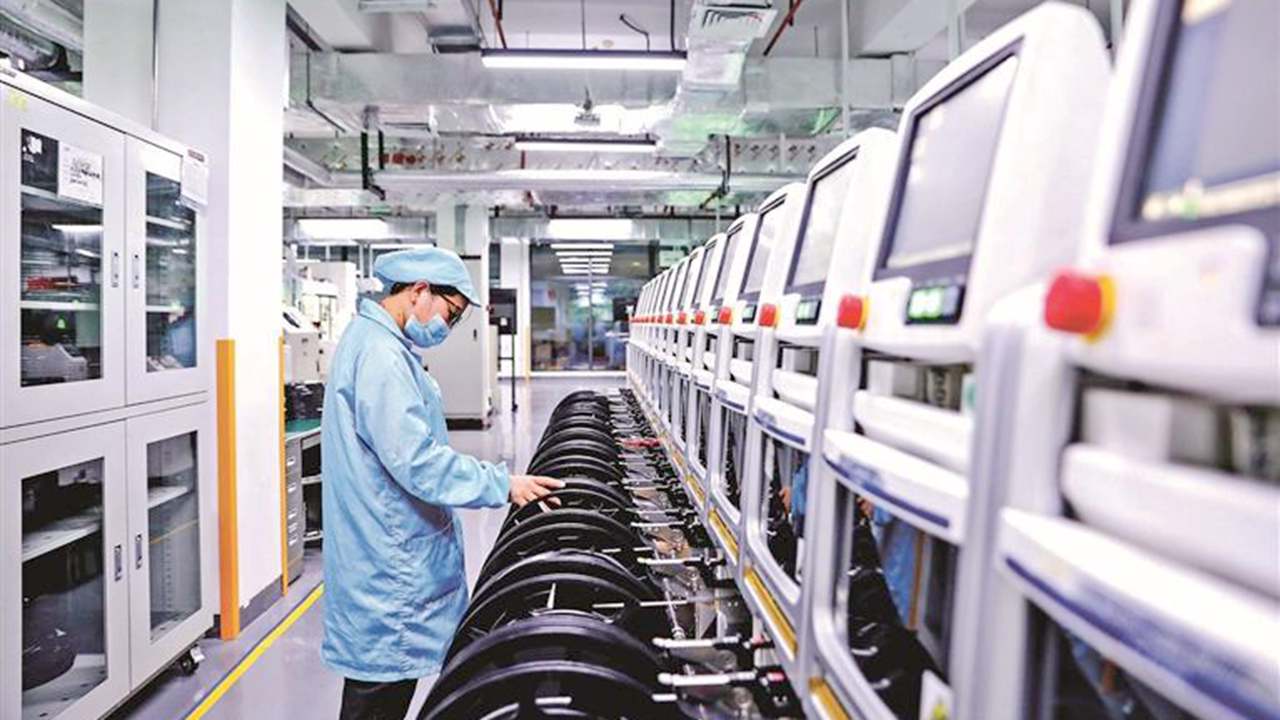
An employee works on a production line at an SME that manufactures display devices in Longhua District. Longhua District's new display device industrial cluster has been recognized as national-level SME industrial clusters with local features recently.
Since the Ministry of Industry and Information Technology (MIIT) unveiled a plan last yearto cultivate around 100 SME industrial clusters with local features, seven Shenzhen SME clusters have been selected as provincial-level clusters, including four national-level ones, with the numbers ranking first in the province.
All of the industrial clusters included on the national list fall into the categories of Shenzhen’s “20+8” industrial clusters, to which the city has attached strategic importance for its future development.
SME industrial clusters with local features are characterized by their focus on leading industries, and their distinctive advantages, features and core competitiveness. When fostering such clusters of industries, the MIIT gives priority to those that help to advance digital transformation, accelerate green and low-carbon development, deepen openness and cooperation, and enhance governance and services. The MIIT is nurturing such clusters as a means for developing SMEs into specialized and sophisticated enterprises that produce new and unique products, as carriers for promoting the regional economy, and as focal points for ensuring security and stability in industrial and supply chains.

A view of Nanshan iPark.
Among the seven recognized Shenzhen SME clusters, Nanshan District’s intelligent terminal chip design industrial cluster and Bao’an District’s lithium battery equipment manufacturing industrial cluster were among the first batch that made it to the national list, while the other five clusters, Nanshan’s intelligent biometrics industrial cluster, Bao’an’s semiconductor packaging and testing equipment industrial cluster, Longgang’s high-end intelligent vehicle equipment industrial cluster, Longhua’s new display device industrial cluster, and Guangming’s medical diagnosis, monitoring and treatment equipment industrial cluster were rated as provincial-level clusters in July this year. The thresholds for the provincial ones include overalloutput exceeding 4 billion yuan in the past three consecutive years and output of SMEs accounting for more than 70% of the industrialcluster’s total.
Longgang District’s high-end intelligent vehicle equipment industrial cluster, newly recognized as a national-level cluster, is the city’s first in the automotive field. Covering an area of 3.49 square kilometers, this industrial cluster includes areas across the Shenzhen International Low Carbon City in Pingdi Subdistrict, Baolong Smart Home Industrial Park and Baolong Specialty New Industrial Park. A balanced upstream and downstream industrial chain has been formed in the area, covering almost all segments of the whole high-end intelligent vehicle equipment sector, such as vehicle navigation, vehicle central control display, vehicle speakers, smart sensors, smart antennas, and intelligent control systems. More than 50% of companies in the cluster have established long-term cooperative deals with leading domestic and foreign car enterprises such as Tesla, BYD, GAC, and Volkswagen.

Nanshan District's intelligent terminal chip design industrial cluster is based in the Chongwen park of Nanshan iPark and covers an area of 21,600 square meters.
Nanshan District’s intelligent terminal chip design industrial cluster, which was among the first to become a national-level cluster, is based in the Chongwen section of Nanshan iParkand covers an area of 21,600 square meters. It currently includes 50 companies, including 48 SMEs. The companies achieved a total output of 13.63 billion yuan in 2022, with 81% coming from the intelligent terminal chip design businesses.
Such clusters, with their advantages in industrial and supply chains, are attracting an increasing number of “small giant” companies to join and thrive.
Longhua District’s new display device industrial cluster, covering an area of 14.58 square kilometers in Guanlan Subdistrict, is home to 61 companies, including 57 SMEs and five “little giant” companies. The cluster’s output reached 31.08 billion yuan last year, with 98.7% coming from new display device businesses.
Bao’an District’s lithium battery equipment manufacturing industrial cluster, based in the Shiyan Tangtou Industrial zone and Fuhai Subdistrict Daojin Industrial Park, covers an area of 5.8 square kilometers. It has gathered five “small giant” companies as well as 83 companies above designated size. With 81% of the companies being SMEs, the cluster achieved an overall output of 16 billion yuan last year, representing a 53% increase from a year ago.