
 Share
Share


 Print
PrintShenzhen, the city that programs itself like software
Writer: Luigi Gambardella | Editor: Lin Qiuying | From: Original | Updated: 2025-10-09
Paris is the city of lights. New York never sleeps. Shenzhen programs itself. Its most radical invention was not a phone, a drone or a microchip, but an idea: that an entire metropolis could function like software — able to observe, simulate, correct and update itself in real time.
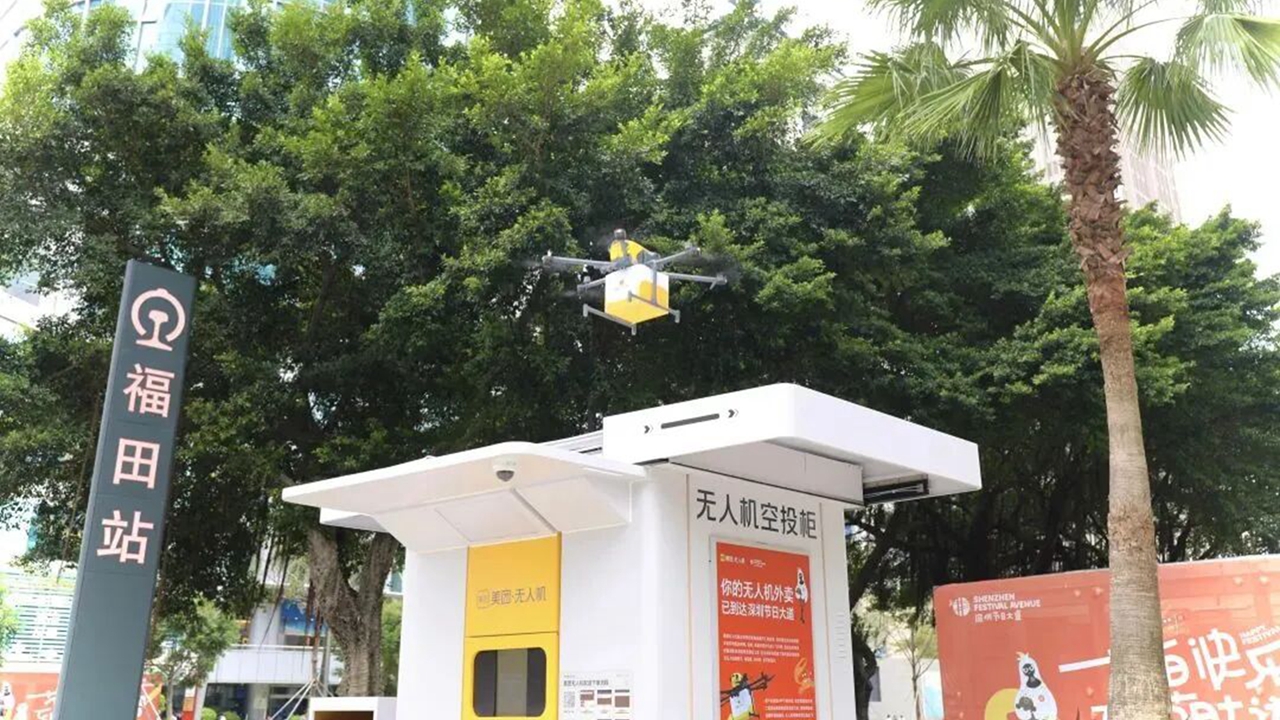
A delivery drone is seen in Futian District. Photo from Shenzhen Special Zone Daily
Arriving in Shenzhen means feeling this difference immediately. The hum of drones hovering over rooftops, the uncanny silence of electric buses gliding down the streets, the glow of digital billboards flashing like notifications: even in the traditional markets, the smell of freshly printed plastic mingles with the steam of noodles. Shenzhen does not look to the future. Shenzhen breathes the future.
The numbers confirm what the senses already suggest. According to official data, today the city has more than 17 million residents and a GDP exceeding US$500 billion. Its metro network — 609 kilometers across 20 lines and 428 stations — was built in under twenty years — a pace that would take generations in Europe. But the most striking figure is its research budget: more than 6% of GDP is invested in R&D, higher than Israel or South Korea and nearly three times the European average. These are not abstract statistics but the heartbeat of a city that feeds on continuous innovation.
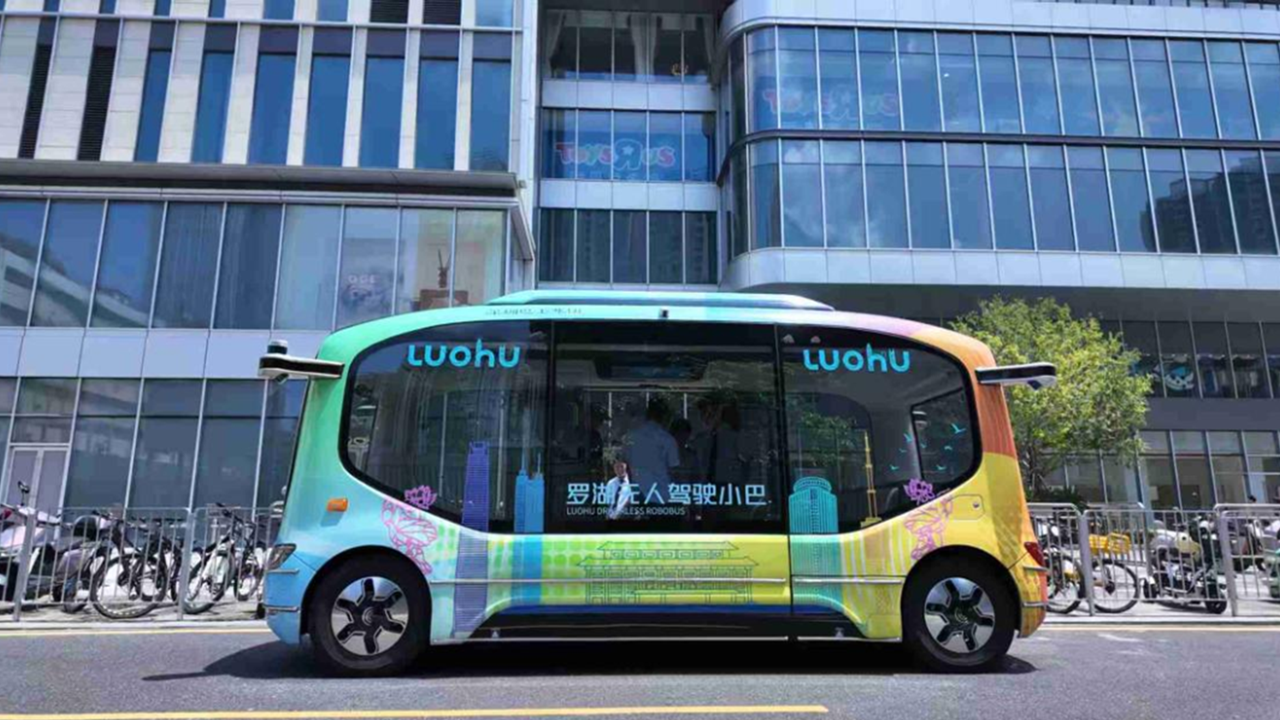
A driverless bus in Luohu District. Photo from Shenzhen Economic Daily
For centuries, cities have been conceived as finished works: a master plan was approved, built, and left untouched until the next upheaval. Shenzhen has chosen a different path. Here, planning is iterative, experimental. Urban policies, public services and mobility models are treated like prototypes: tested in pilot districts, corrected in real time and rapidly scaled. Entire neighborhoods function as digital twins, simulating traffic, energy consumption and service delivery, and adapting almost instantly. “Our true infrastructure is not the cables, it is transparency. Without it, no intelligent system can endure,” a data bureau official once told me. Unsurprisingly, in a city that constantly reinvents itself, this may be the simplest and yet most radical definition of Shenzhen’s philosophy.
Shenzhen is not alone in this venture. Singapore with its Smart Nation, Barcelona with open civic data, Tallinn with digital governance: all are experimenting with forms of urbanism that behave more like algorithms than like urban plans. Yet none has done so with the same speed and scale. In 2024, Shenzhen installed more than 20,000 rapid charging stations for electric vehicles, electrifying virtually its entire fleet of buses and taxis. In Berlin or Paris, a similar program would have required years of debate, consultation and political wrangling. Here, a few decisions are enough to redesign the mobility of millions.
Of course, such speed has its costs. Programming a city like software carries social risks. Not everyone can keep up with the pace. A national survey in 2024 found that more than 40% of young workers in China’s high-tech cities reported feeling under constant pressure. Shenzhen is emblematic: innovation is its strength but also its vulnerability. The same velocity that enables radical transformation also generates precariousness and uncertainty.
And yet Shenzhen remains a unique global laboratory. It is not a model to replicate mechanically, but an example that forces us to rethink the very concept of the city. It shows how urban development will no longer be written solely by architects and engineers, but also by programmers, data analysts and computational scientists. The metropolis becomes a dynamic system, capable of updating itself like software.
The real question is not whether Shenzhen is an exception, but whether Europe will have the courage to update its cities with the same frequency. For now, most European capitals remain bogged down in procedures, appeals and endless consultations, while Shenzhen redesigns its mobility in a matter of months. With each passing day, the gap widens. And perhaps, in this race, it will no longer be enough to start the engine. We will have to learn how to program.