
 Share
Share


 Print
PrintDesktop quantum computing and SpinQ's quiet revolution
Writer: Luigi G | Editor: Lin Qiuying | From: Original | Updated: 2025-10-11
Quantum computing is often portrayed as the domain of giants: inaccessible superconducting labs, billion-dollar investments, companies like Google, IBM or Alibaba racing for technological supremacy.
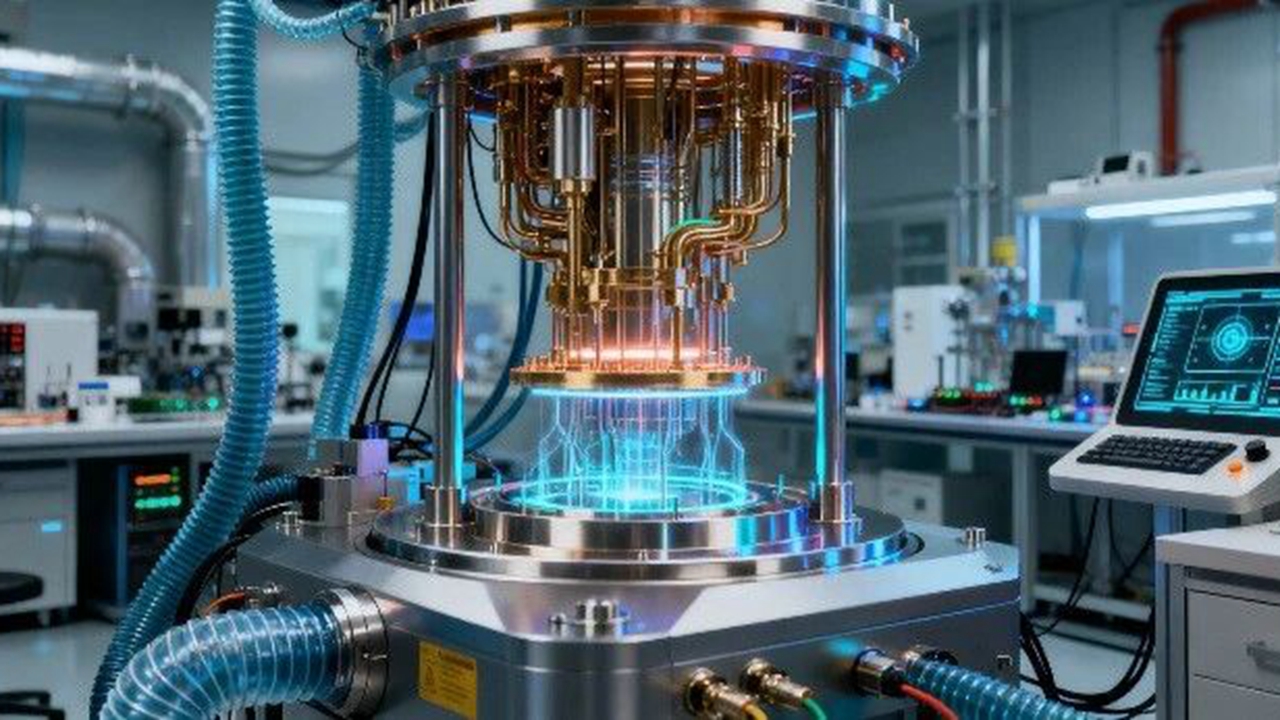
Image generated by Doubao
Yet, far from Wall Street spotlights and headline-grabbing promises, there are those trying to democratize access to quantum computation — bringing it from cryogenic chambers to university labs and even classrooms.
Shenzhen-based SpinQ has chosen a different path: nuclear magnetic resonance (NMR) quantum computers, running at room temperature, compact, quiet, relatively affordable, and designed for education and basic experimental research.
Products such as Gemini and Triangulum — with 2 and 3 qubits respectively — are not meant to beat IBM in the race to “quantum advantage.” Instead, they aim to teach how quantum computing works, allowing students and young researchers to manipulate real qubits, run elementary algorithms, and observe errors and corrections.
This strategy has two fundamental merits. First, it lowers the entry barrier in a field that risks remaining the preserve of a handful of monopolistic players. A desktop quantum computer, even with limited capacity, builds familiarity, sparks curiosity, and trains the next generation of talent. Second, it bets on a more pedagogical than industrial model, focusing on the academic ecosystem and training rather than sheer performance.
Naturally, the limitations are clear. NMR systems do not scale: they remain confined to a few qubits and face structural challenges in preparing pure quantum states. No one expects SpinQ to challenge billion-dollar projects based on superconductors or trapped ions. But measuring them with the same yardstick would be a mistake. These devices were never designed to compete, but to spread quantum knowledge and skills.
Here lies a political and industrial lesson Europe would do well to consider. While Brussels debates “technological sovereignty” and how to close the gap with the U.S. and China, investments in accessible educational platforms may have a faster and more widespread impact than any multibillion-euro program. When a university lab buys a “bench-top quantum computer,” it is not just adding a new tool: it is nurturing talent, creating a shared language, and preparing the ground for future researchers and entrepreneurs.
SpinQ is showing that quantum computing is not only a vertical race to increase qubit numbers. It can also be a horizontal challenge — of diffusion and democratization. And in a world where technology risks becoming ever more concentrated, this democratization may be the greatest innovation of all.