
 Share
Share


 Print
PrintUnraveling the 'Shenzhen Mystery': A conversation with Alan Macfarlane
Writer: Zhang Yu | Editor: Lin Qiuying | From: Original | Updated: 2025-11-03
Video by Wang Haolan
When Alan Macfarlane first set foot in Shenzhen a decade ago, his mind’s eye, shaped by a career studying the gritty realities of 19th-century British industrial history, prepared him for the worst.
He expected a chaotic, smoke-choked city cluttered with dirty factories and the grit of unbridled manufacturing. What he found upended that narrative entirely — a gleaming metropolis of 17 million where lush, green spaces coexist with soaring skyscrapers and rapid growth is balanced by unexpected order.
For the renowned Cambridge anthropologist, who has spent decades decoding civilizational transformations from the British Industrial Revolution to the global impact of tea and glass, this was not just another city — it was a “detective story.”
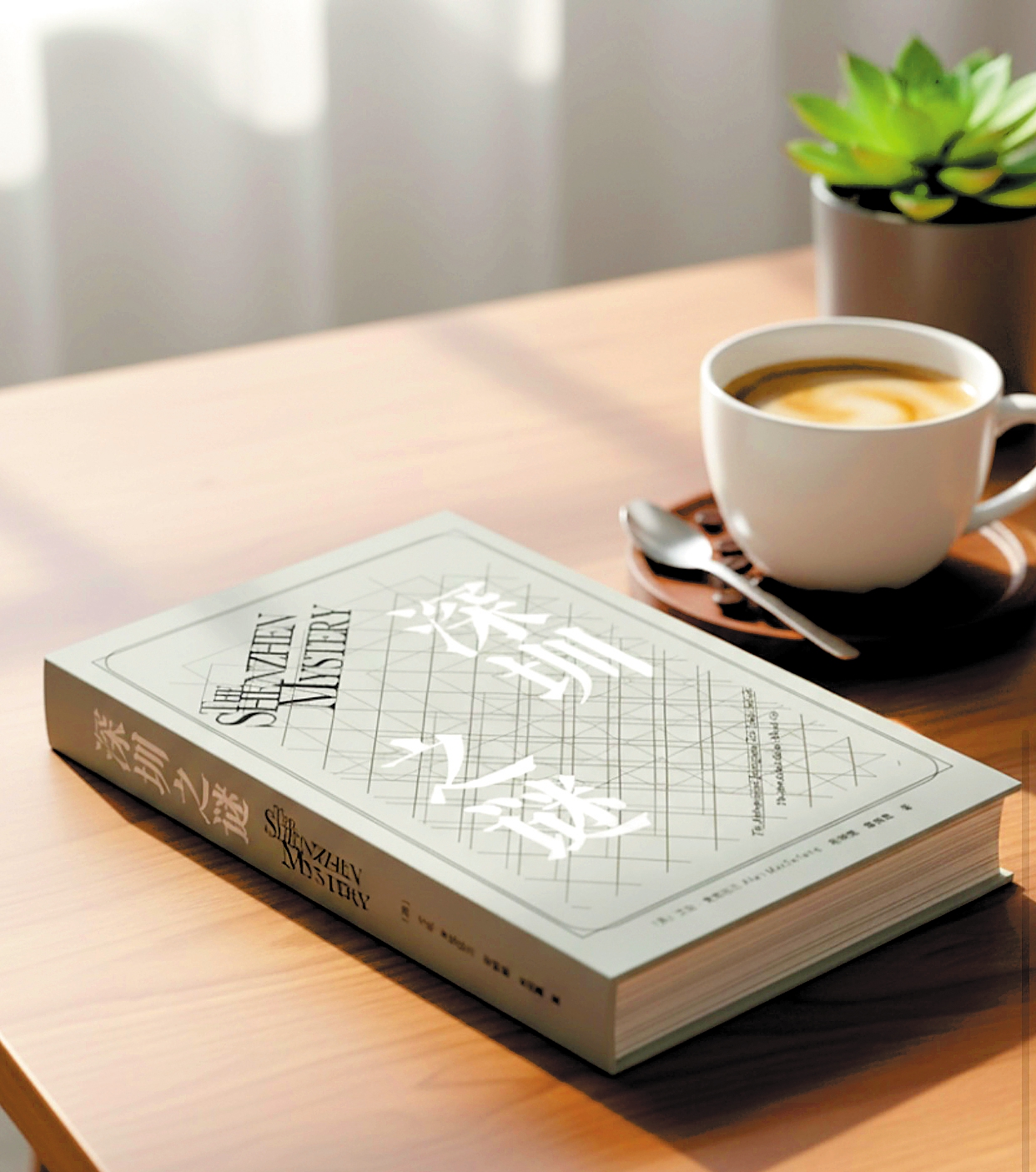
Alan Macfarlane's new book, "The Shenzhen Mystery." File photo
He unpacks that mystery in his new book, “The Shenzhen Mystery.” In a wide-ranging interview with Shenzhen Daily, Macfarlane explained the ancient roots of the city’s modern success, why its meteoric rise defies easy explanation, and whether its model offers a blueprint for a world grappling with urbanization and stagnation.
The chemistry of a miracle
Macfarlane rejects the notion that Shenzhen is an anomaly. “Most great transformations are equally mysterious, but I really am always very interested in something which has changed the world hugely,” he said. “No one has ever been able to explain them properly. Certainly, Shenzhen fits into that category.”
His fascination began with a stark contradiction: a city that grew from a small fishing village to a global hub in mere decades, yet lacked the squalor he associated with industrialization.
“I assumed that it would be a horrible mess — like visiting a 19th-century industrial city in England,” he recalled. Instead, he was taken to the Shenzhen Library, a modern structure leading to a hilltop statue of Deng Xiaoping, with no sign of soot or overcrowding to be seen.
The analogy he returns to is cooking — one that becomes a throughline in his book. “Most people think explaining growth is like listing ingredients for Kung Pao Chicken,” he explained. “But ingredients alone don’t make a meal. You need a recipe — timing, quantities, [and] how to mix them. That’s the hard part.”
For Shenzhen, the “ingredients” are obvious: the special economic zone (SEZ) policy, proximity to Hong Kong, and a deep seaport. The “recipe” — how those elements interacted with culture, history, and human behavior — is the elusive chemistry that makes it a mystery. “I haven’t solved it,” he admitted. “But I’ve tried to map the ingredients and some of the ‘chemistry’ — and I hope someone else will pursue the ‘detective story’ further.”
Ancient roots of modern success
When asked about the most overlooked factor in Shenzhen’s success, Macfarlane’s answer was unexpected. “The Chinese themselves. Not just modern Chinese, but the deep, ancient traits of Chinese civilization.”
Many observers frame Shenzhen as a “blank slate” — a product of 20th-century reform. But Macfarlane argues that it draws on traditions stretching back millennia. “Taoism, Buddhism, the family system, even the legacy of the first emperor of [the] Qin Dynasty. All these are factors which feed into what has happened in Shenzhen.”
He points to the work of 19th-century French missionaries who wrote about Chinese traders everywhere and how Japanese financiers in the 1800s considered Chinese merchants “better with money.” That entrepreneurial spirit, he argues, was not created by Shenzhen, but unleashed by it. “Migrants came because they saw a place where a small sum could become an empire. The fun of making money — of building something — is deeply Chinese.”
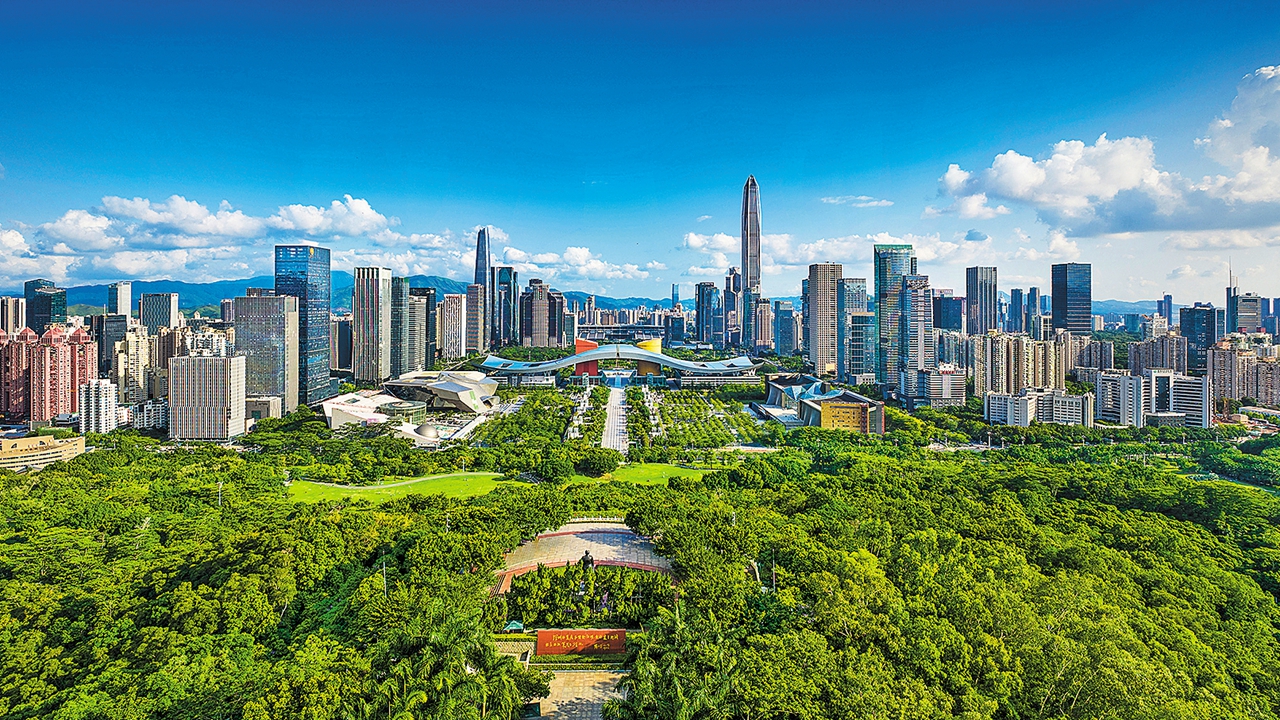
A view from the top of Lianhua Hill, with the statue of late Chinese leader Deng Xiaoping and modern structures such as the Shenzhen Library in sight. Xinhua
Equally important were the skills of the migrant workforce. “People assume they were farmers, but many were skilled craftsmen — designers, builders,” he noted. “I once wrote about a Shenzhen skyscraper where workers built one floor every three days. No workman in the West could do that. They had a natural flair for detail, for workmanship — skills honed over generations.”
The delicate balance of the SEZ
A central concept in Macfarlane’s book is “bounded but leaky” — his term for Shenzhen’s SEZ status, which he says is key to its success. The idea comes from a friend, an industrialist who built glass factories across Asia. “He said, ‘If you are starting a business, what you need is to protect the business against rivals and everything. But if you make it too protected, then it will just disappear.”
To illustrate, he uses a coastal metaphor. “Imagine a rock pool on Shenzhen’s shore. The pool is ‘bounded’ — it holds water and creatures. But if the tide stops coming in (no ‘leakiness’), the water stagnates, and everything dies. If there’s no pool (no ‘boundedness’), the tide sweeps everything away.”
Macfarlane uses the example of a pregnancy to further explain this idea. Initially, the placenta is highly bounded, as the embryo requires little sustenance. However, as the embryo develops and its need for nutrients and “information” from the mother increases, the placenta’s boundedness gradually decreases.
This delicate balance between over-protection and under-protection allows Shenzhen to attract foreign investment and ideas while maintaining its distinctiveness within the broader Chinese context.
New model of modernity
For Macfarlane, modernity is not about skyscrapers or smartphones, though Shenzhen has plenty of both. “Modernity is about separating spheres of life — economics with its own laws, politics with its own, law independent of power,” he explained.
Shenzhen, he argues, is a “pool of modernity” within China and “a good example of modernity,” thanks to its nature as a SEZ. Here, the political sphere withdrew to allow the economy to flourish under a robust legal system that protected private property and finance. This allowed market forces like supply and demand to operate freely, making Shenzhen a distinctly modern city.
Contrasting Shenzhen’s experience with the gritty industrial cities of 19th-century Britain, Macfarlane marvels at the city’s ability to achieve industrialization at a breakneck pace while maintaining remarkable cleanliness and livability. “It’s like an industrial city in the middle of a park.”
He attributes this to the city’s deliberate decision to prioritize ecological sustainability and invest in green spaces and pollution control measures. “The Shenzhen government realized that this is not just good for people, but also for economic growth,” he observed. “Ecological decisions improve life and not only make people happier, but also wealthier.”
The ‘Magic Triangle’ in the AI age
Alan Macfarlane frames the “Magic Triangle” — the cycle from theoretical discovery to object design and then mass production — as not just a framework for understanding economic development, but a lens to decode Shenzhen’s extraordinary rise.
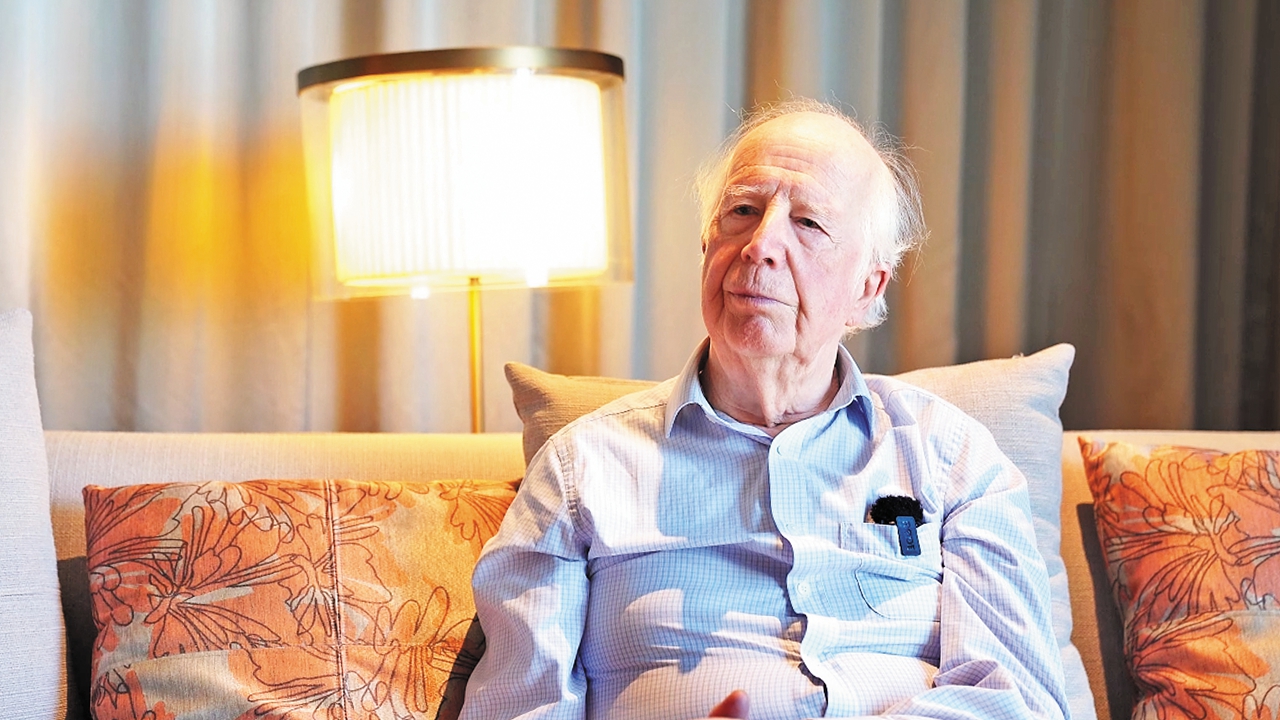
Alan Macfarlane during an interview with Shenzhen Daily. Wang Haolan
As he noted in the interview, this cycle starts with abstract knowledge (like Newton’s optics or Boyle’s vacuum theory), evolves into tangible innovations (a telescope, a steam engine), and scales into mass-produced goods that reshape industries. Historically, wars, trade disputes, or resistance slowed this cycle — but Shenzhen has kept it spinning, a resilience that now uniquely positions it for the AI age.
AI is redefining the “Magic Triangle” by removing human bottlenecks. “The triangle now spins faster and faster,” Macfarlane explained. Unlike in the past, when the cycle relied on humans (thinkers, inventors, workers) and faced delays, AI drives theoretical breakthroughs (new algorithms), designs innovations (AI-optimized hardware), and accelerates mass production (automated factories) at an unprecedented speed.
Shenzhen’s role in this AI-era cycle is already visible. When Macfarlane returned after 18 months, he was struck by the city’s rapid transformation. This pace stems from its ecosystem — firms like Huawei, Tencent, BYD, and DJI, skilled workers, and a collaborative culture that fuels the triangle.
Lessons for the world
The most potent lesson from Shenzhen, according to Macfarlane, may not be a blueprint for replication, but an inspiration for pragmatic adaptation. The city’s meteoric rise is, as he argues, uniquely Chinese and deeply rooted in its specific context. “It’s an inspiration. It gives hope,” he said.
To expect it to be carbon-copied in the American Rust Belt or a developing African nation is to misunderstand its essence. Its true value for global policymakers lies not in its specific policies, but in its underlying philosophy: a relentless, forward-looking pragmatism.
The real challenge for the West, particularly the U.S., is one of posture. Macfarlane suggests that the path to renewal begins with a humility that has largely been absent — a willingness to learn from China’s successes as China once learned from the West.
“If instead of putting tariffs and ridiculous things on China,” he proposed, “the American government sent people from the Rust Belt… to China and said, ‘how did you do this?’” The potential is there, contingent on a shift from rivalry to open, pragmatic inquiry.
Critical to that lesson is Shenzhen’s embrace of ecological sustainability — a choice Macfarlane says the U.S. has abandoned in favor of outdated policies like “drill, baby drill.” Shenzhen has proved green growth isn’t a cost but a catalyst for wealth and happiness.
While the “mystery of Shenzhen” has not been fully solved in his investigation, Macfarlane remains optimistic that more about the extraordinary world that has grown in Shenzhen will be discovered and explored. One thing is certain — the baton has now been handed to Shenzhen to tackle pressing global challenges.