
 Share
Share


 Print
PrintChinese, Russian experts gather in Guangming for cooperation in molecular medicine
Writer: Windy Shao | Editor: Zhang Chanwen | From: Shenzhen Daily | Updated: 2025-11-21
More than 150 experts and scholars from China and Russia convened in Shenzhen’s Guangming District from Nov. 16 to 17 for the 2025 International Forum on Innovation Cooperation in Molecular Medicine, hosted by Shenzhen University of Advanced Technology (SUAT) in partnership with the Russian Association of Molecular Medicine and Experimental Genetics Experts.
Centered on the theme “Shaping a Healthy Future: Individualized, Inclusive and Global,” the forum explored new pathways for innovation and international collaboration in molecular medicine.
The event focused on three major goals: joint scientific research, collaborative talent development, and deep industry–academia integration. Participants discussed how cutting-edge technologies in molecular biology and nuclear medicine can be integrated with traditional medical practices to address global challenges such as antibiotic resistance, major infectious diseases, and malignant tumors, accelerating the translation of scientific breakthroughs.
Zhu Dijian, Party secretary of SUAT, said the university will join hands with Russian partners to advance quantitative biology. He highlighted plans to push breakthroughs in ophthalmology and dental molecular technologies, and to harness digital tools for precision medicine. SUAT, he added, is committed to achieving original innovation in fundamental research and building ethical and legal frameworks for the integration of digital and biotechnologies, contributing to a “global community of health for all.”
Russian Minister of Health Mikhail Murashko delivered remarks online, noting the solid progress of China–Russia medical cooperation. To date, Russia has registered more than 100 Chinese pharmaceuticals and 3,500 medical devices, while the two sides are jointly advancing 28 scientific and educational cooperation projects and have published 223 academic papers. These achievements, he said, lay a strong foundation for deeper collaboration in policy coordination, joint research, and talent training through the forum.
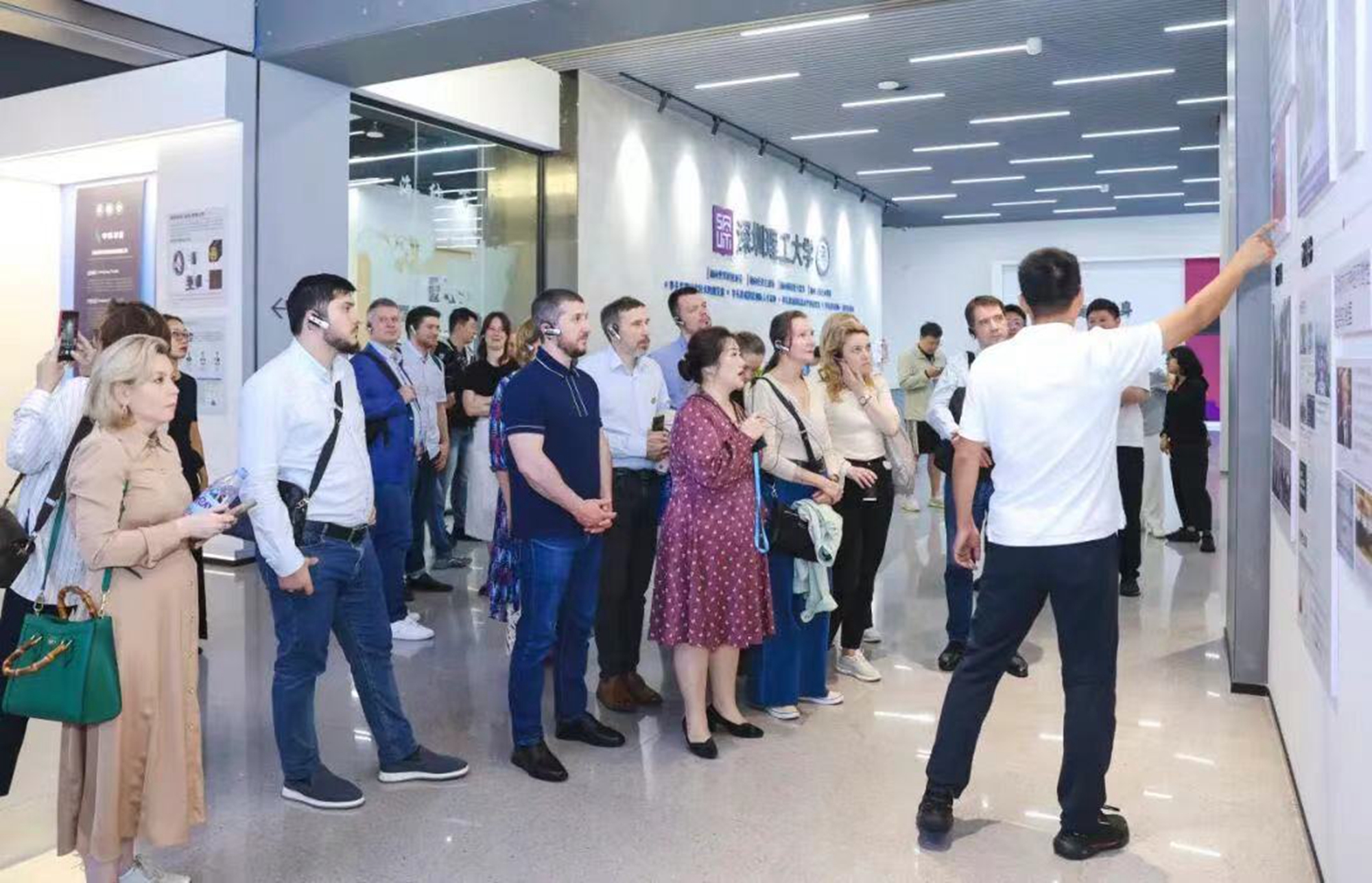
Russian experts visit Shenzhen University of Advanced Technology during the forum. Courtesy of the event organizers
During the keynote sessions, Xu Zhiming, executive director of SUAT’s Future Medicine Center and dean of the Faculty of Clinical Medicine, presented on “Reshaping Future Healthcare: From Clinical Needs to Space Solutions,” sharing the center’s development roadmap and five space medical experiment results conducted in cooperation with the Shanghai Micro-Satellite Engineering Center. Chen Youhai, dean of SUAT’s Faculty of Pharmaceutical Sciences, introduced advances in cancer immunotherapy and AI-driven drug discovery, highlighting efforts to break through conventional R&D bottlenecks.
Sub-forums featured in-depth discussions on molecular technologies, personalized medicine, regenerative medicine, clinical ophthalmology, and future pediatrics, fostering academic exchange and cooperation matchmaking.
On Nov. 17, attending experts visited several major innovation platforms in Shenzhen, including the Shenzhen Brain Science and Technology Industrial Innovation Center, the Shenzhen Engineering Biology Industrial Innovation Center, and the National Center for High-Performance Medical Devices, gaining firsthand insights into the city’s growing biomedical and health-tech ecosystem.