
 Share
Share


 Print
PrintIntl. media delegation explores cutting-edge science in Guangming
Writer: Windy Shao | Editor: Zhang Chanwen | From: Original | Updated: 2025-11-27
A delegation of international journalists and foreign online influencers participating in the 2025 “A Date with China” media program visited Guangming District on Nov. 26, embarking on an immersive journey into the region’s fast-growing ecosystem of scientific innovation.
The group toured the Shenzhen Synthetic Biology Infrastructure and the Shenzhen Brain Science Infrastructure at Guangming Life Science Park before heading to the Industrial Innovation Center for Brain Science and Technology.
They gained first-hand insight into the district’s rapidly expanding capabilities in synthetic biology, brain science, and science communication.
Shenzhen Synthetic Biology Infrastructure
The Shenzhen Synthetic Biology Infrastructure is one of China’s most advanced national scientific infrastructures and the world’s largest standardized, automated, and intelligent synthetic biology platform.
Researchers demonstrated the facility’s automated experimental equipment, where robotic arms conducted yeast-engineering procedures with precision.
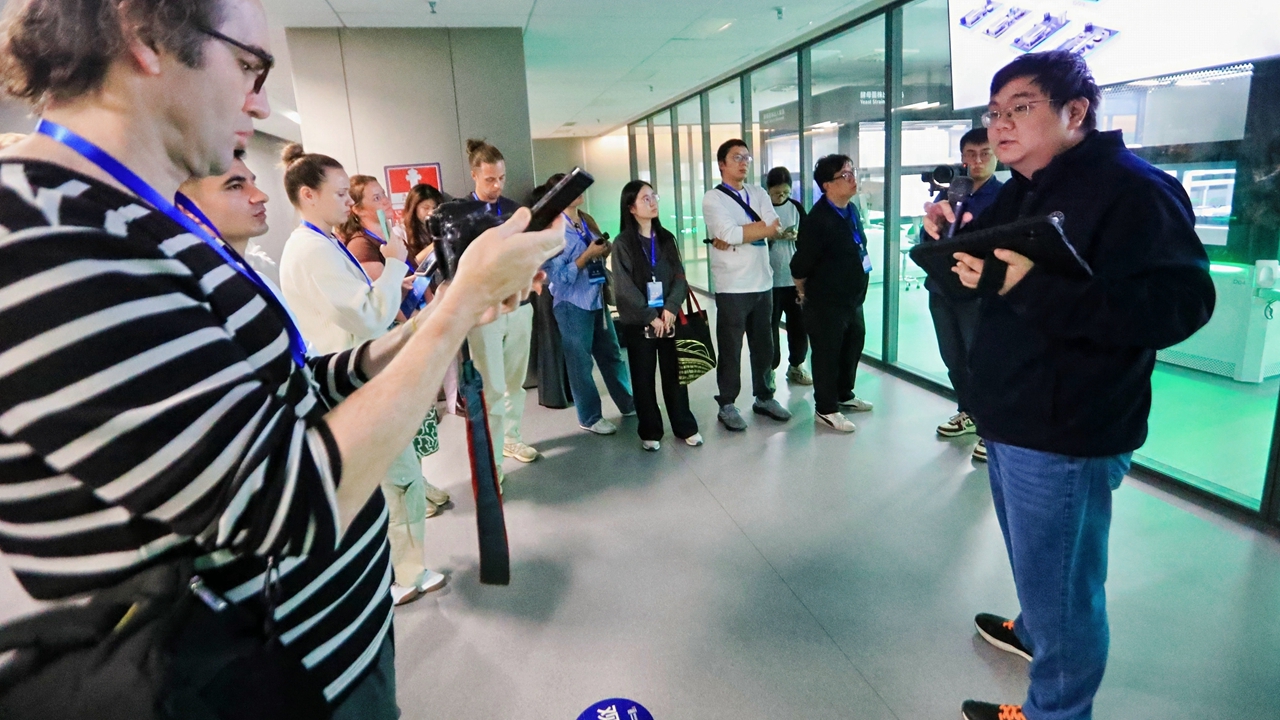
A staff member from the Shenzhen Synthetic Biology Infrastructure introduces the facility to members of the delegation. Photos by Sun Yuchen
Since its official launch in 2024, the facility has provided services to 97 universities, institutes, and enterprises, fueling the formation of a vibrant local industrial cluster. More than 120 synthetic biology companies have settled in Guangming, with a combined valuation of 40 billion yuan and an annual output exceeding 4 billion yuan.
Brain Science Infrastructure
As a flagship project in the launch area of Guangming Science City, the Shenzhen Brain Science Infrastructure is designed to accelerate breakthroughs in brain science, brain-inspired intelligence, and brain-related medical technologies.

Delegation members visit Shenzhen Brain Science Infrastructure.
Researchers introduced the facility to the visiting guests, explaining that it integrates three core technological modules — Brain Editing, Brain Analysis, and Brain Simulation — forming the world’s first comprehensive innovation platform for brain science. It houses a large-scale animal science center capable of supporting research from rodents to non-human primates, and provides advanced multimodal imaging resources, including MRI systems of multiple bore sizes and field strengths, as well as PET and CT equipment.
Brain innovation center
The delegation next visited the Industrial Innovation Center for Brain Science and Technology, a specialized platform jointly supported by the Shenzhen Institute of Advanced Technology (SIAT) of the Chinese Academy of Sciences and the Shenzhen-Hong Kong Institute of Brain Science.
The center focuses on key challenges in brain health, brain disorders, brain-inspired intelligence, and translational technologies. It has attracted more than 50 resident enterprises and successfully incubated five graduating companies.
One of its signature initiatives — the Brain Health Cabin, designed with AI-based cognitive assessment tools — has delivered 12,000 brain-health screenings to local communities, offering new models for elderly care.
For many visitors, the brain-health applications were among the most compelling.
“The focus on brain diseases and elderly care really impressed me,” said Emre Aytekin, a journalist from Türkiye’s Anadolu Agency. “The screening programs and technologies for treating degenerative brain conditions feel very hopeful for the future.”
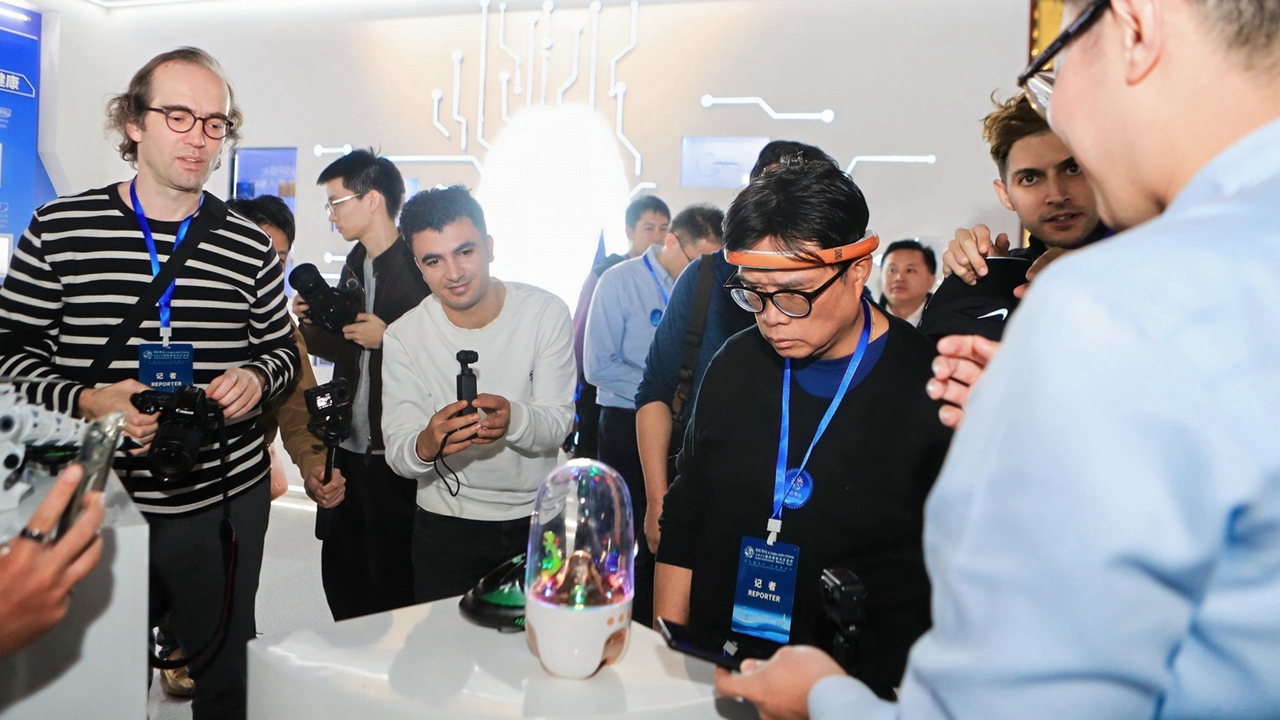
Delegation members try a product at the Industrial Innovation Center for Brain Science and Technology.
The influencers also expressed admiration for Shenzhen’s innovation momentum.
“It’s amazing to see how much science and technology are being developed here,” said Noelia Rodriguez Pascual, a Mexican creator with more than 7.8 million YouTube followers. “I’ve lived in Shenzhen for a year and a half, but this is my first time in Guangming—one of the city’s unexplored gems.”
British influencer Lightfoot Jason Richard highlighted China’s growing technological self-reliance.
“We learned that many of the machines used here used to be imported,” he said. “But now, they’re increasingly being designed and built in China. It’s inspiring to see this shift toward greater independence.”
Backgrounder: Guangming Science City and Science City Forum
Guangming Science City was approved for development by the CPC Shenzhen Municipal Committee and the city government in April 2018. In just a few years, it has rapidly emerged as one of China’s most dynamic and fast-growing hubs for scientific and technological innovation.
Today, more than 22 major scientific and technological platforms are under construction or already in operation. The Shenzhen Synthetic Biology Infrastructure and the Shenzhen Brain Science Infrastructure are among the first to enter operation.
In 2024, Guangming Science City ranked 7th nationwide on the “Top 100 Science Cities in China” list, underscoring its rising national influence.
Scheduled for early December, the 2025 Guangming Science City Forum will be held under its permanent theme, “Guangming · Building the Future.” The 2025 edition will focus specifically on “Openness · Intelligent Innovation · Leadership,” reflecting both the city’s development trajectory and global scientific trends.
A core highlight of this year’s forum will be the release of a series of new achievements from Guangming’s major scientific infrastructure clusters, offering a comprehensive look at the city’s growing strength in cutting-edge science and technology.