'SZ sets example for building child-friendly city'
Ever since Shenzhen started building a child-friendly city at the end of 2015, the city has rolled out a spate of measures, which includes the release of the country’s first guidelines in both Chinese and English for building child-friendly communities, schools, libraries, hospitals, parks, travel systems and baby care rooms.
Experts have recognized Shenzhen’s years-long efforts, believing that the city has served as a paradigm for other cities.
“Shenzhen has explored a path of child-friendly city construction with distinctive characteristics in terms of top-level design, policy formulation and practice,” said Xu Yushan, a researcher at the Shenzhen Academy of Social Sciences.
“For example, to build a child-friendly school, it was mentioned to increase children’s activity space in the classroom corridor,” said Xu, who was referring to the guidelines for the construction of a child-friendly public service system the city released in May.
Xu was a witness for the guidelines’ preparation and review process. “As the guidelines were the first such kind in the country, we looked up a large number of materials and revised them repeatedly in the formulation process,” she said.
“But it was also because the guidelines were the first in the country that there would be far-reaching significance and great influence,” Xu noted.
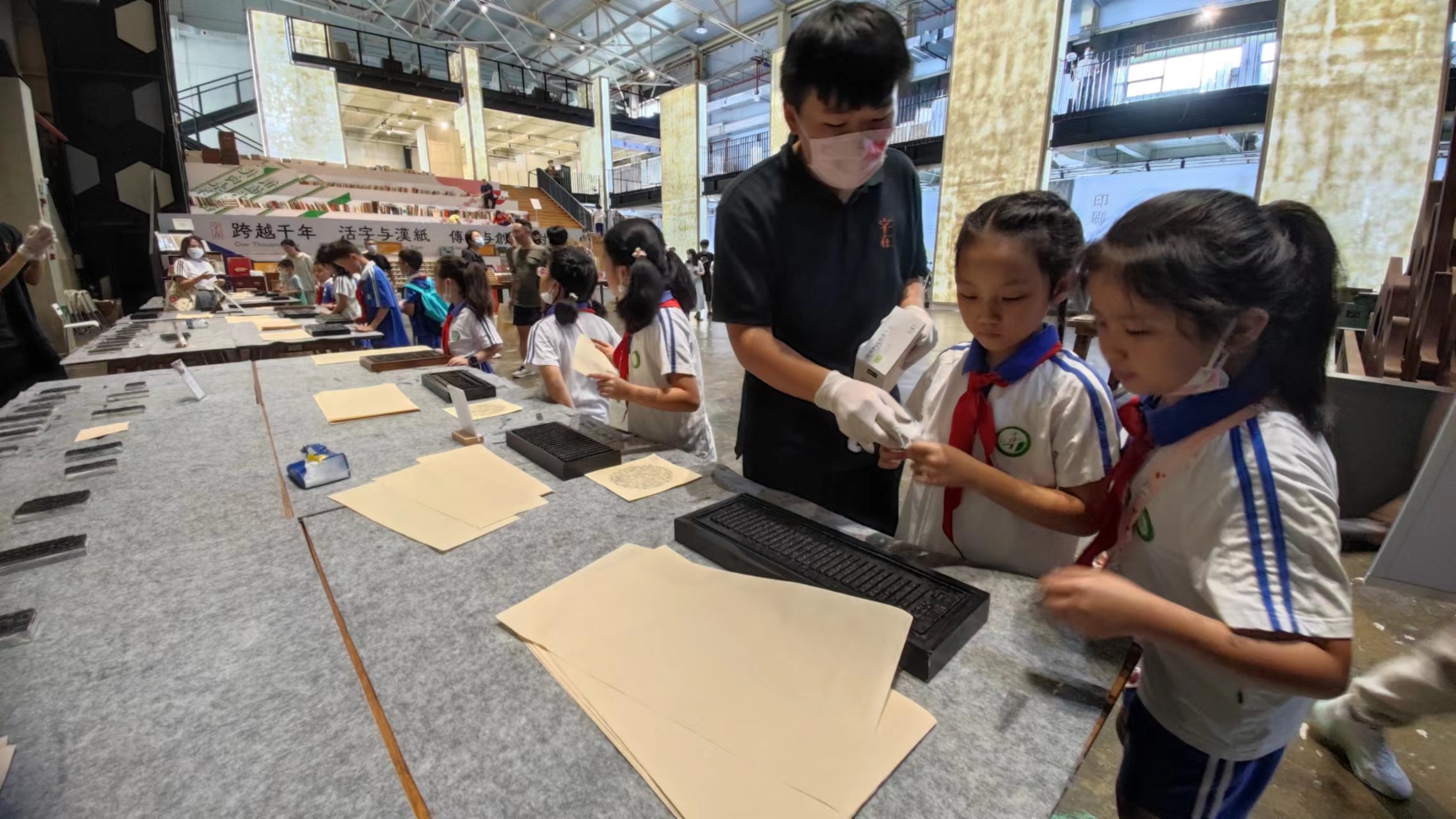
Primary school students try to print with movable type at an exhibition featuring the printing craft and traditional Chinese paper making at I-Factory in Shekou, Nanshan District in August. Sun Yuchen
Xu added that a child-friendly city has taken shape in Shenzhen over the past few years. The construction guidelines for libraries, hospitals, schools, travel systems and baby care rooms compiled years ago have given institutional support for facilities, while the new guidelines provide a direction for building a child-friendly city in terms of services.
Hu Weihua, head of Shenzhen Polytechnic’s tourism development research institute, believed that Shenzhen has provided pioneering experience in building a child-friendly city, with the guidelines filling the gap in the public service standards that cater to children’s needs.
“Child care support for young families has undoubtedly become an important factor in improving city competitiveness, and Shenzhen has been a model working on that,” said Zhang Xinyue, an architect from the China Academy of Urban Planning & Design Shenzhen.
According to Zhang, urban planning is a powerful intervention tool, which can provide a strong guarantee for the construction of elderly- and child-friendly cities from the perspective of physical space.
Child-friendly city: what it is and why it matters
A child-friendly city (CFC) is a city, town, community or any system of local governance committed to improving the lives of children within their jurisdiction by realizing their rights as articulated in the U.N. Convention on the Rights of the Child, according to UNICEF.
In practice, it is a city, town or community in which the voices, needs, priorities and rights of children are an integral part of public policies, programs and decisions.
Launched by UNICEF and U.N.-Habitat in 1996 in a U.N. conference, the Child Friendly Cities Initiative (CFCI) was proposed to respond to the challenges of realizing the rights of children in an increasingly urbanized world. The U.N. conference declared that the well-being of children is the ultimate indicator of a healthy habitat, a democratic society and good governance.
The CFCI is a network that brings together government and other stakeholders such as nongovernmental organizations, the private sector, academia, media and children themselves who wish to make their cities and communities more child-friendly.
Since its inception, CFCI has been actively adopted in over 3,000 cities and communities worldwide, according to statistics. At present, many cities around the world have joined in building child-friendly cities, such as London and Munich.
According to UNICEF, beyond the legal imperative as stated in the U.N. Convention on the Rights of the Child, there are other compelling reasons to make children a priority. A significant reason is that the healthy development of children is crucial to the future well-being of any society.
China will carry out pilot child-friendly city schemes in approximately 100 cities by 2025, according to the National Development and Reform Commission (NDRC).
“Children are the future of the country and the hope of the nation. China is a country with a large population of children. It is our greatest wish to let children grow up better,” Ou Xiaoli, an official from the NDRC, said at a press conference in 2021.
China had around 298 million children between the ages of 0 and 17, according to the country’s seventh national population census data released last year.