
 Share
Share


 Print
PrintForeign investors move to Shenzhen to tap into its manufacturing, tech prowess
Writer: Yang Yunfei | Editor: Liu Minxia | From: | Updated: 2024-04-22
In an interview with Shenzhen Daily in March, Taylor Ogan, CEO of U.S. hedge fund Snow Bull Capital, said that Shenzhen’s rapid technological development was the main reason he decided to move his company from Boston to the southern China booming city in January 2023.
“We weren’t going to move to China if we didn’t move to Shenzhen. It wasn’t even a question,” he said. “Shenzhen represents the future. There is no city that is newer and greener, and has more technology than Shenzhen.”
Founded in Boston in 2018, Snow Bull Capital focuses on investing in high-tech, clean-tech and green-tech companies, which, according to Ogan, truly make people’s lives better.
Shenzhen has a lot of those companies, and many of them are undiscovered, he said. “So, as an investor, I see opportunities here.”
Technological innovation
Dubbed China’s Silicon Valley, Shenzhen is the country’s tech hub and now home to many leading Chinese tech companies, including gaming giant Tencent Holdings, telecom champion Huawei Technologies, drone maker DJI, humanoid robot maker UBTech Robotics and new energy vehicle giant BYD Co.
As one of the pioneers in the world to promote the adoption of new energy vehicles, which Ogan is closely following and very bullish on, Shenzhen led the country, the world’s largest new energy vehicle market, with the adoption rate reaching 50.39% in earlier April from 1.3% in 2015, with 1.79 million electric vehicles and plug-in hybrid cars manufactured in 2023. The number of new energy vehicles running on the roads in Shenzhen also swelled to 970,000 units last year, the largest in China, official figures show.
 Taylor Ogan (C), CEO of Snow Bull Capital, and his co-workers at the company’s office in Houhai, Nanshan District. Lin Jianping
Ogan said that he saw the growing prevalence of new energy vehicles, robotaxis and charging facilities as examples of Shenzhen’s innovative environment, which also appeals to other foreign investors seeking development opportunities brought by China’s growth stories.
As China further opens up its market to foreign investors and promotes the new quality productive forces that are intended to introduce a technological and innovation-fueled economic transformation, Shenzhen, the original test bed for China’s reform and market-opening initiatives, has shown a strong desire to lure foreign investments by creating a market-oriented, law-based and internationalized business environment.
Traditionally, Shenzhen's economy had been driven mainly by labor-intensive and capital-intensive industries, but now it is increasingly fueled by technological innovation.
Shenzhen’s innovation culture attracts brilliant minds and drives technological breakthroughs. From hardware manufacturing to artificial intelligence and robotics, the city is a hotbed of innovation across industries and offers foreign investors a compelling investment landscape with its unique blend of technological prowess, favorable business environment and remarkable growth potential.
Apple lab
In its latest move to tap into Shenzhen’s manufacturing and research and development (R&D) prowess to produce the best products, U.S. tech giant Apple Inc. announced March 12 that it would set up an applied research lab in the city later this year.
The new lab is expected to boost Apple’s testing and research capabilities for its major products, including the iPhone, iPad and Vision Pro mixed-reality headset. The new facility will also serve to strengthen Apple’s collaboration with local suppliers and the U.S. firm will deepen its cooperation with local companies to cultivate a complete industrial chain covering design, R&D, commercial transformation, and production for new products.

Employees work at an Apple lab in this file photo. Coutesy of Apple
Shenzhen firms have played an indispensable role in Apple’s supply chain and the city remains an important center for manufacturing the iPhone maker’s products.
Two of the three heads of Apple’s key Chinese suppliers CEO Tim Cook met in Shanghai during his latest visit to China in March are from Shenzhen: Wang Chuanfu, chairman and chief executive of BYD, and Chen Xiaoshuo, CEO at electronic components manufacturer Shenzhen Everwin Precision Technology.
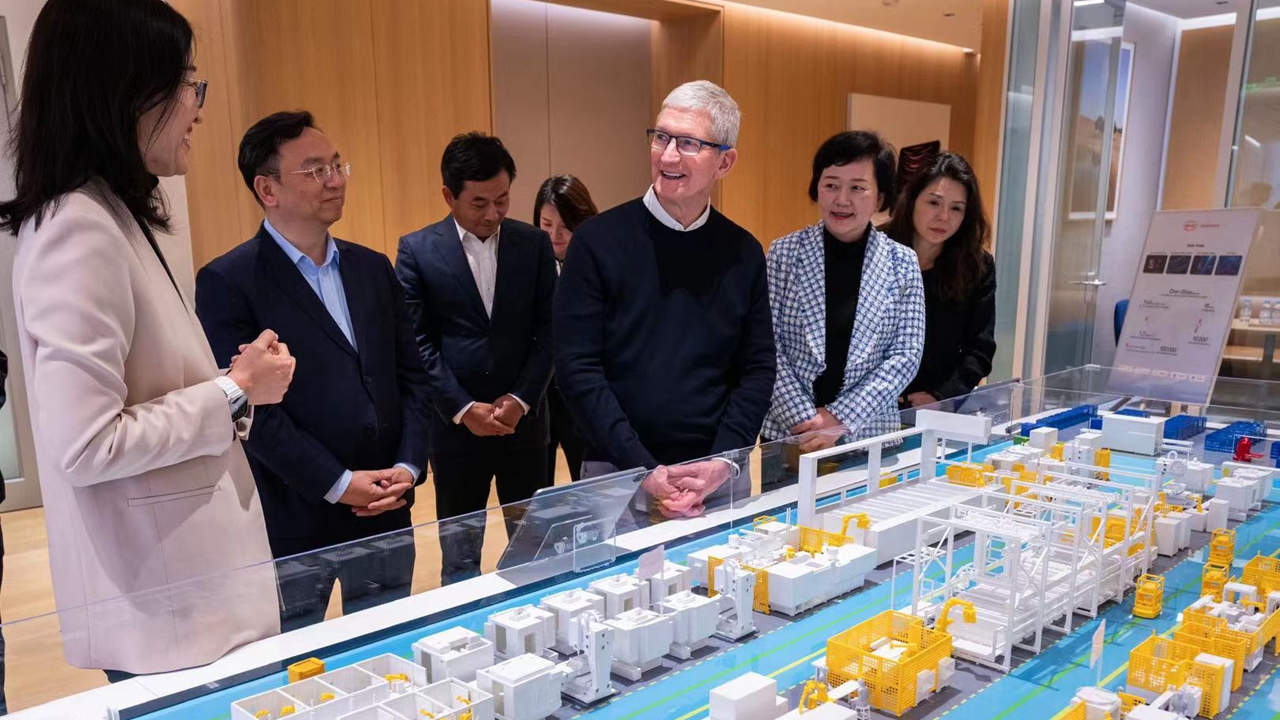 Wang Chuanfu (2nd L), CEO of Shenzhen-based BYD, Tim Cook (3rd R), Apple CEO, Isabel Ge Mahe, Apple’s vice president and managing director of China division, and Iris Cui (2nd R), vice president of Asia procurement and operations at Apple, stand beside the sand table of BYD’s smart factory during their meeting in Shanghai In March. Courtesy of Apple
Cook was effusive in his praise of the “high level of modernization in Chinese factories, with very advanced manufacturing capabilities and well-trained workers” after a sharing session, where the three suppliers showcased their latest achievements and progress in smart, green manufacturing, and talent training. “There's no supply chain in the world that's more critical to us than China,” Cook said.
Shenzhen’s vibrant tech ecosystem and manufacturing prowess are believed to be the main factors behind Apple’s decision to select the city for its new lab. This also mirrors the U.S. firm's intention to tap into local talent and resources, thereby strengthening its innovation capabilities, analysts said.
R&D centers
In recent years, Shenzhen has emerged as a preferred destination for internationally renowned foreign-funded firms to establish R&D and innovation centers.
Currently, Shenzhen has lured 15 of the world's top scientific research and technology service firms, including Intel, Qualcomm, Apple and ARM, covering areas such as intellectual property services, inspection and testing, strategic consulting, aerospace, biomedicine, high-end equipment manufacturing and chip manufacturing and design.
Open, inclusive and innovative, Shenzhen has become a hotbed for global investment. The number of newly established foreign-funded firms in Shenzhen recorded an increase of 86.6% year on year in 2023 to 8,002 and the actual use of foreign investment in the city reached 62.62 billion yuan (US$8.70 billion), ranking first in Guangdong.
Shenzhen’s efforts to promote high-quality foreign investment also proved to be fruitful. Official data show that in 2023, the number of newly launched foreign firms in the city’s manufacturing industry increased 53.8% compared with a year ago, while the number of new foreign firms in high-tech industries jumped 60.6% from a year earlier.
The momentum of foreign capital making its way into Shenzhen remains strong this year, with the number of newly launched foreign-funded firms expanding 29.8% year on year in the first two months of the year to 1,121, or about 15.7% of the country’s total, and the actual use of foreign capital hitting 7.04 billion yuan, accounting for 32% of Guangdong’s total.

Siegfried Boerst, regional managing director of LEGOLAND China, speaks to journalists during the 2023 Shenzhen Global Investment Promotion Conference in December 2023. Liu Xudong
“Shenzhen is a very modern city. It has a lot of innovative companies in the technology sector. I think there’s a very bright future for Shenzhen,” said Siegfried Boerst, regional managing director of Legoland China, which plans to build the world’s largest Legoland resort in Shenzhen.
Investment from developed economies
Official data show that developed economies have increased their investment in Shenzhen. From January to October in 2023, investments from Canada, the United States, Singapore, and Switzerland in Shenzhen grew rapidly, expanding 655%, 272%, 148%, and 77%, respectively.
This comes amid amid “de-risking” moves from Western economies. It shows that the Chinese market still has a strong attraction for global capital, and also indicates a shift in foreign investment towards R&D and manufacturing with a preference for tech cities, said Cao Zhongxiong, director of the Department of Digital Strategy and Economics at the China Development Institute.

Cao Zhongxiong, director of the Department of Digital Strategy and Economics at the China Development Institute. File photo
Cao said that developed countries are increasing investment subsidies in their domestic advanced manufacturing and new energy industries, while developing countries, such as India and Vietnam, become more attractive to foreign capital. It has been more difficult to attract global investment for Chinese cities like Shenzhen.
Cao said Shenzhen's achievements in attracting foreign investment are the result of persistent efforts and proactive outreach for investment, along with the continuous introduction of policies for industrial development and foreign investment attraction.
“What's more important is Shenzhen's complete technology industry chain, innovation chain, and supply chain, which align with the current investment preferences of industrial capital from developed countries, fundamentally encouraging foreign investment to favor Shenzhen,” Cao said.
Technology and innovation
In a survey jointly conducted by the China Development Research Foundation and accounting firm PricewaterhouseCoopers (PwC) and released in March, Shenzhen came in first in the two dimensions of technology and innovation and ease of doing business. The city also secured the third position in the overall city ranking, following Beijing and Shanghai, and was among the top five in other dimensions including urban resilience, culture and quality of life, and economic clout.
The Chinese Cities of Opportunity 2024 report ranked 57 Chinese cities from 10 dimensions and 50 variables.
In the dimension of technology and innovation, Shenzhen ranked first in patent authorization and new energy development. The city ranked third in high-tech enterprises and digital cities, with an accelerated convergence of innovative resources and outstanding technological strength.

A view of Shenzhen. Xinhua
According to another survey released by PwC last year, Shenzhen will continue to attract foreign-funded firms as the city moves to improve its industrial and supply chain structures, as well as its scientific and technological innovation capacities.
GE HealthCare Technologies Inc. sped up its investment in Shenzhen last year by sealing two deals in the city.
The U.S. medical technology company announced in February that it teamed up with China National Medical Device Co., a subsidiary of giant domestic drugmaker Sinopharm, to develop, manufacture and commercialize medical equipment to address the growing needs of China's health care market. It has also joined hands with Shenzhen Bay Laboratory and the Shenzhen Medical Academy of Research and Translation in industry-university-research cooperation.
“All these are impossible without Shenzhen’s economic vitality, innovative atmosphere, supply chain system, talent pool and international exchange environment," Zhang Yihao, CEO and president of GE HealthCare China, said.