
 Share
Share


 Print
PrintZigzag walls can make buildings cooler
Writer: Han Ximin | Editor: Zhang Zeling | From: | Updated: 2024-08-22
Researchers devised a new, electricity-free design for vertical walls that can cool the building more efficiently than conventional walls. These zigzags, just a few centimeters wide, can reduce daily average wall temperatures up to 3°C degrees Celsius without using any energy,according to a research paper was recently published in Nexus, a cutting-edge multi-disciplinary journal under Cell Press.
Buildings currently consume about 40 percent of global energy and account for over a third of global carbon dioxide emissions, a large fraction of which comes from energy-intensive air conditioning. The use of air conditioning is surging as the world heats up and the number of people who can afford it increases. Greenhouse gas emissions from cooling could more than triple by 2050. As a result, many teams are trying to develop passive cooling solutions that don’t require any energy.
For instance, simply making roofs white so they reflect more sunlight can keep buildings and cities cooler. This approach is even more effective if roofs are coated with materials that reflect most sunlight but emit infrared radiation within the atmospheric transparency window. This is the range of wavelengths that isn't absorbed by molecules in the atmosphere such as carbon dioxide.
While materials with these properties have a significant cooling effect on roofs facing upwards, they aren’t as effective on walls. The issue is that materials that are good at emitting infrared are also good at absorbing it, and surfaces near walls, such as concrete pavements, can radiate lots of infrared.
Dr. Qilong Cheng, the first author of the paper, came up with a solution to have walls with a series of protrusions running parallel to the ground with a zigzag shape when viewed from the side. To visualize this, imagine a flight of stairs tilted up from a 45 to a 90 degree angle.
“With this kind of design, we can have a cooler building,” said Dr. Cheng, a postdoctoral researcher at Columbia University, at a recently interview.
Crucially, the upwards-facing zigs – the treads in the staircase analogy – have a surface that emits lots of heat in the atmospheric transparency window, while the downwards-and-outwards facing zags – the risers – have a surface that reflects infrared heat rather than absorbing it.
There are a number of cheap materials available with the necessary properties, said Dr. Cheng. Existing buildings could be retrofitted by adding corrugated panels. The interior cooling effect will vary depending on other factors, such as the size of the building’s windows, but simulations suggest it could be up to 2°C, reducing the energy needed for cooling by up to a quarter.
The zigzag cooling walls would only be suitable for hotter climes as they would increase the need for heating in winter in colder regions. But Dr. Cheng and his colleagues have also proposed a design with hinged “fins” that can be raised in winter to increase heat absorption and lowered in summer to minimize this.
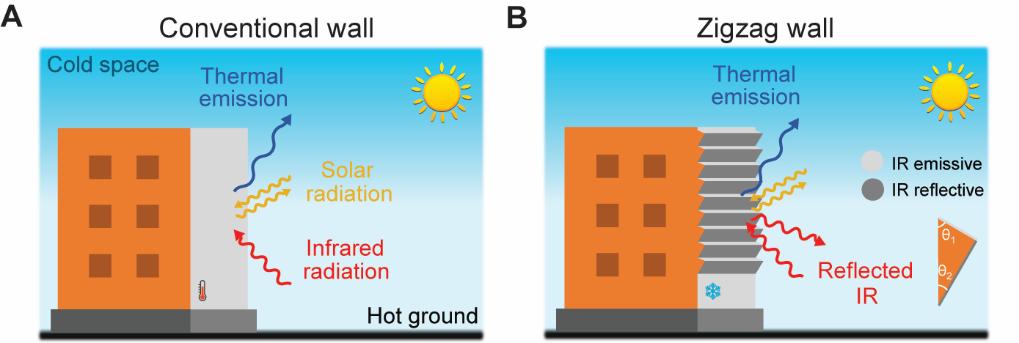
Schematics of conventional wall (left) and zigzag wall (right).
This zigzag wall design can cool off a building by reflecting both incoming solar radiation (yellow) and heat from the ground (red), while also emitting heat, as long-wave infrared radiation (blue), back to space. It provides a practical solution for cooling buildings in the current warming world, expediting the transition to a carbon-neutral society.
Link for the research paper:https://doi.org/10.1016/j.ynexs.2024.100028