
 Share
Share


 Print
PrintMuseum displays calculating marvels
Writer: Cao Zhen | Editor: Lin Qiuying | From: Original | Updated: 2024-12-30
In the supercomputing era, a new exhibition themed on ancient calculations is allowing visitors to appreciate the ingenuity and mathematical prowess of our ancestors and explore historical calculation devices and tools at the Shenzhen Museum’s Ancient Art Division.
Over 230 items are on display, ranging from ancient Chinese abacuses and Andean quipu knotted strings used for keeping records to a brick from the Eastern Han Dynasty (25-220) inscribed with the Chinese multiplication table and replicas of Babylonian clay tablets featuring a derivative table.
A visitor views abacuses from the Qing Dynasty (1644-1911) at the exhibition. Photos by Cao Zhen
Notable Western items from the 19th and 20th centuries include a Fuller’s cylindrical slide rule, the Genaille-Lucas rods, a circular Columbus calculator, and a Brunsviga 10 calculator. Highlighting modern advancements, a superconducting quantum chip developed in 2023 by SpinQ Technology Inc. in Shenzhen demonstrates China’s progress in quantum computing.
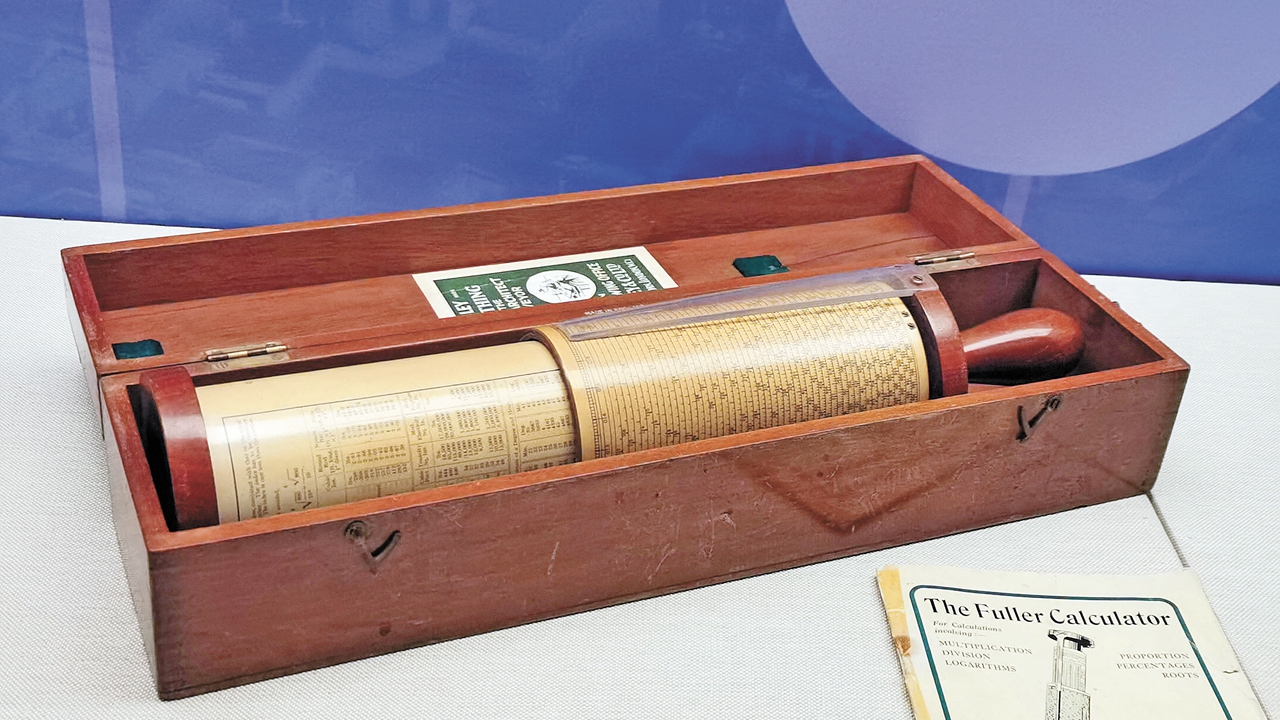
A Fuller’s cylindrical slide rule.
Co-organized by the Shenzhen Museum, the National Museum of Chinese Zhusuan, the Hefei Zimuyuan Museum, and the Tsinghua University Science Museum (currently under development), the exhibition explores human achievements in calculation and computing, with a special focus on China’s mathematical heritage.
Chinese Zhusuan, which includes calculation with the abacus, has been recognized by UNESCO as an intangible cultural heritage. At the exhibition, visitors can try their hand with abacuses, experiencing this time-honored method of calculation firsthand.
Dates: Through March 30, 2025
Venue: Shenzhen Museum’s Ancient Art Division, Futian District (深圳博物馆古代艺术馆)
Metro: Line 9 to Hongling South Station (红岭南站), Exit A