
 Share
Share


 Print
PrintChina-ASEAN joint innovation base launched
Writer: Wei Jie | Editor: Lin Qiuying | From: Original | Updated: 2025-12-01
A collaborative innovation base for emerging industries between China and ASEAN countries was officially inaugurated Friday in Qianhai during the 2025 ASEAN-China GBA Economic Cooperation (Qianhai) Forum.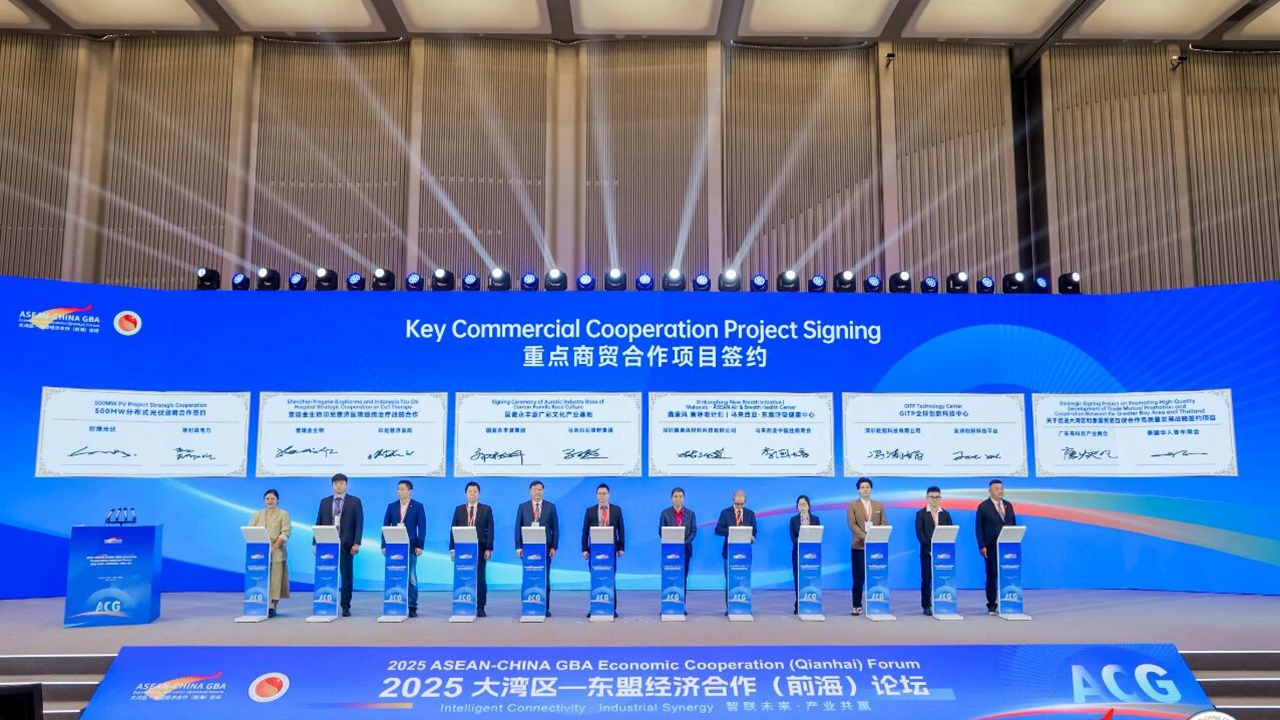
Delegates participate in a key commercial cooperation project signing ceremony at the 2025 ASEAN-China Greater Bay Area Economic Cooperation (Qianhai) Forum in Shenzhen on Friday. Photos courtesy of event organizer
The launch ceremony included the signing of agreements with the forum's first batch of co-construction partners, marking a new milestone in cross-regional cooperation between China and ASEAN. The first phase of the demonstration base will feature four core hubs in Shenzhen, Guangzhou, Singapore, and Kuala Lumpur.
The forum was co-hosted by the China-ASEAN Center and the Shenzhen municipal government and organized by the Qianhai Authority, Shenzhen University, and the Guangdong High-Tech Industry Chamber of Commerce. More than 1,000 participants attended, including senior officials and business association representatives from China and ASEAN countries such as Cambodia, Laos, Malaysia, Myanmar, the Philippines, Singapore, Thailand, and Vietnam.
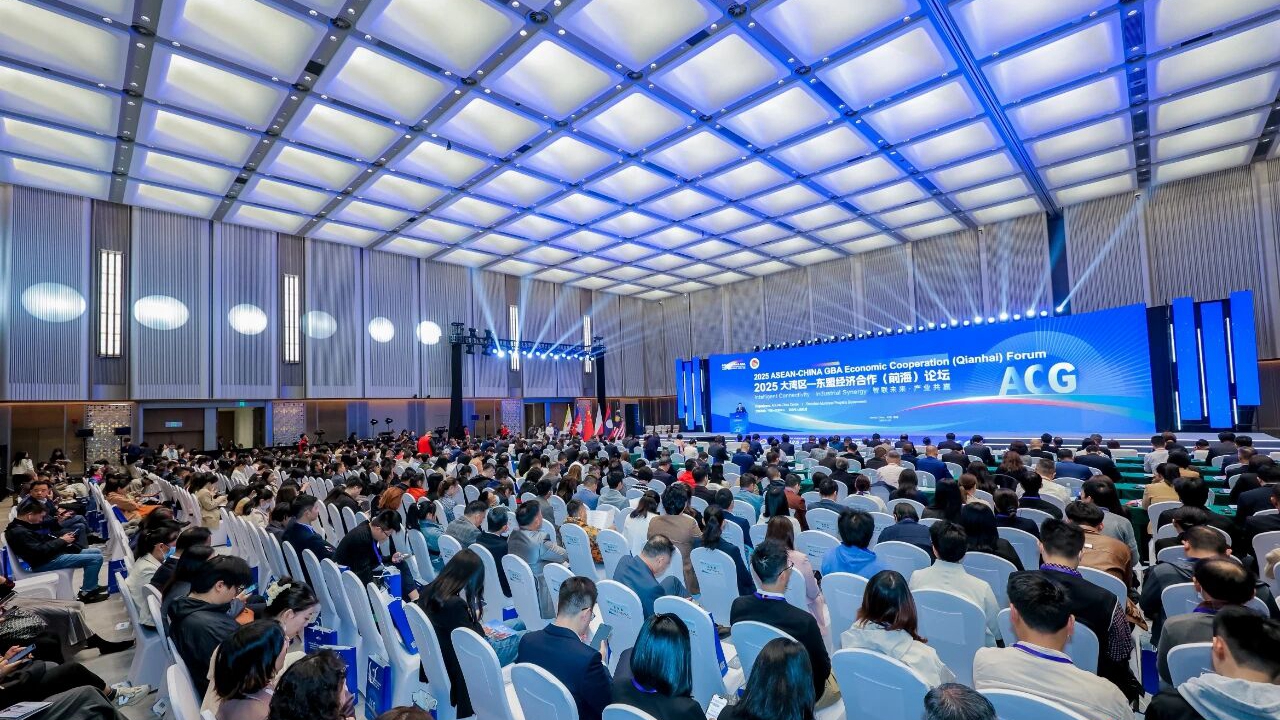
The 2025 ASEAN-China GBA Economic Cooperation (Qianhai) Forum draws more than 1,000 participants from China and ASEAN member countries.
Since its launch in 2023, the ASEAN-China GBA Economic Cooperation (Qianhai) Forum has seen rapid progress. The inaugural forum secured contracted projects worth 12.1 billion yuan (US$1.67 billion). By the 2024 session, project implementation had nearly reached 30 billion yuan. This year's forum further advanced cooperation with two landmark initiatives.
The China-ASEAN Collaborative Innovation Base is designed as an integrated platform for the demonstration of emerging technologies, alignment of industrial standards, policy coordination, and industry-science-technology collaboration. This cross-border innovation platform and policy network is expected to strengthen synergies between China and ASEAN across emerging industries.
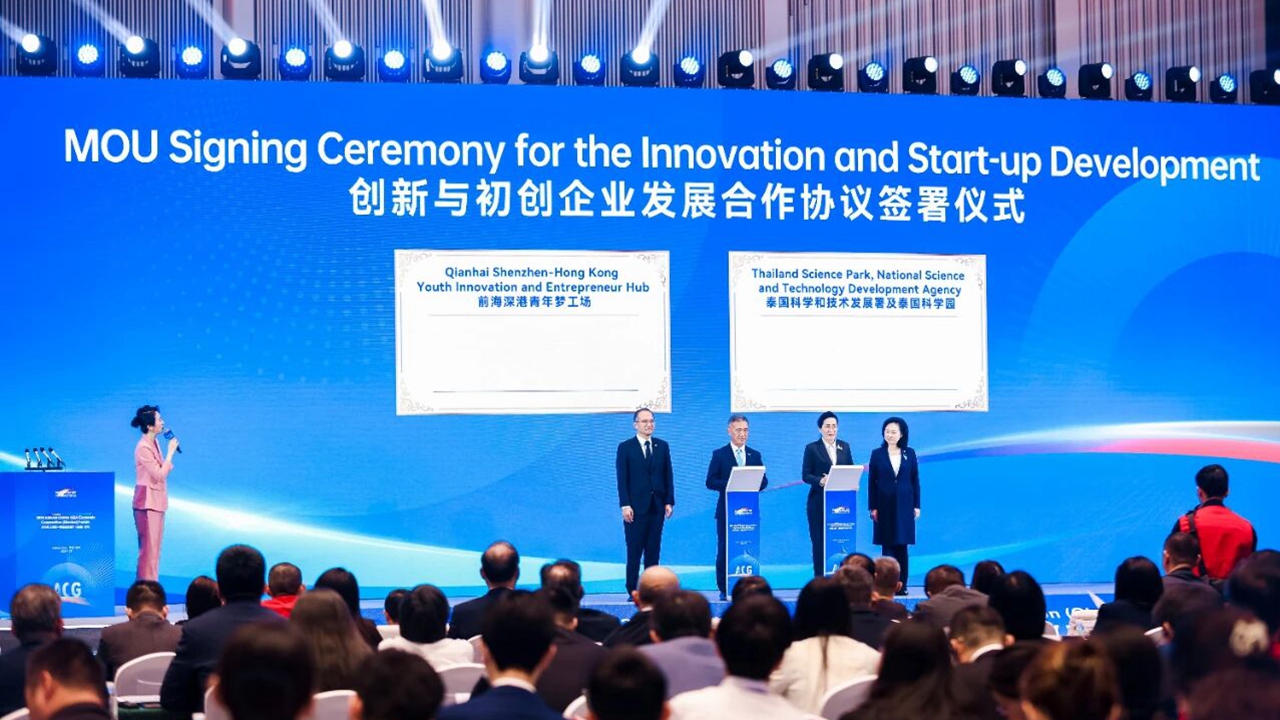
Representatives from the Qianhai Shenzhen‑Hong Kong Youth Innovation and Entrepreneur Hub and Thailand’s National Science and Technology Development Agency pose for a photo after signing an MOU on cooperation during the forum.
Also launched in Qianhai on Friday was the AI Security, Trustworthiness and Responsibility (AI STR) International Open Laboratory. As the world's first cross-border laboratory focusing on the ethical governance of AI, it will develop a leading AI capability verification and security testing platform built around a core model of standards, open evaluation, certification, and international mutual recognition.
The forum's project signing session yielded more than 20 cooperation agreements spanning technology, energy, healthcare, and culture. Notably the Qianhai Shenzhen-Hong Kong Youth Innovation Enterprises Hub signed a cooperation agreement with Thailand's National Science and Technology Development Agency on innovation and startup development.
The Guangdong-Hong Kong-Macao Greater Bay Area-ASEAN Legal Service Cooperation Center was jointly established by the Qianhai "Belt-and Road" Legal Service Federation and law firms from seven countries, including Singapore and Thailand.
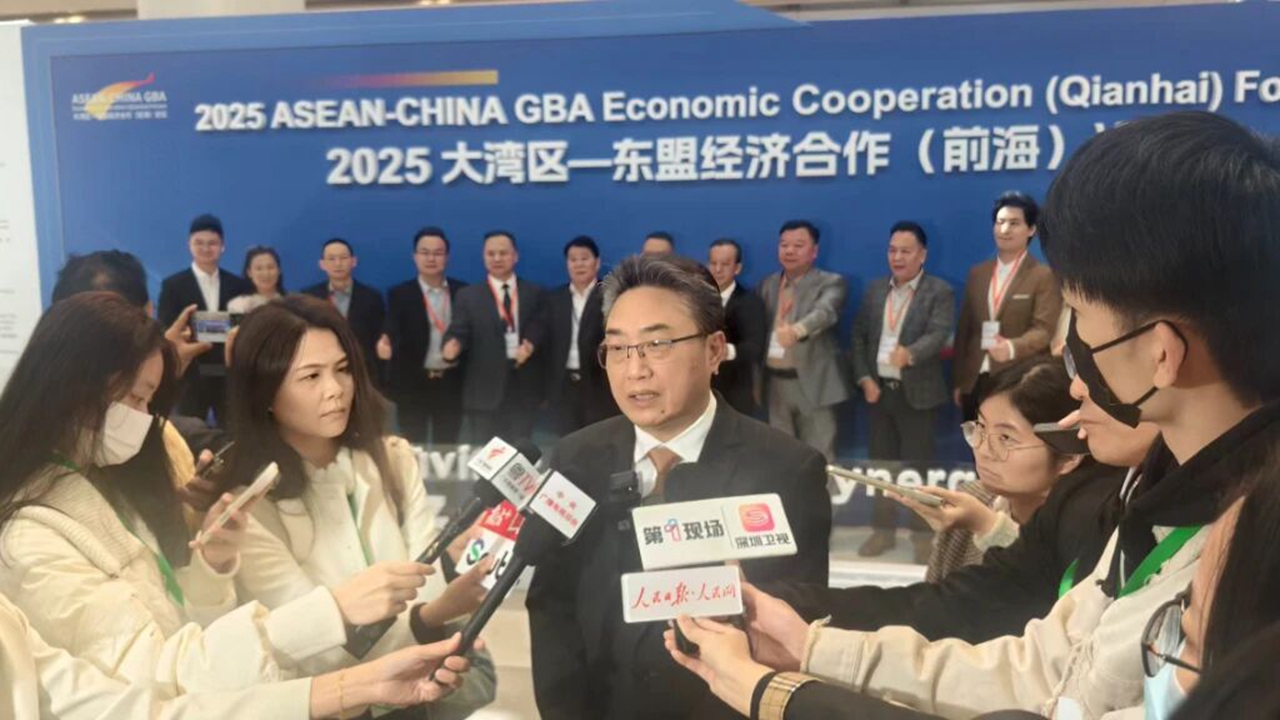
Shi Zhongjun, secretary general of the China-ASEAN Center, speaks to journalists during the forum.
Shi Zhongjun, secretary general of the China-ASEAN Center, said that against a backdrop of slowing global growth and rising unilateralism and protectionism, China and ASEAN are working together to open a broader window for economic integration. He expressed hope that this forum will help build a closer network of exchanges and cooperation and deepen collaboration in areas like digital intelligence.
Dr. Sam Lo, chief president of the Hong Kong Commerce and Industry Associations, said on the sidelines of the forum Friday that Shenzhen and Hong Kong have become highly integrated. Over the next three years, he said the focus will be on promoting the industrial chain's collective expansion into ASEAN and building a new cooperation model of "GBA R&D + ASEAN production."
Lo added that the association has set up seven liaison offices across the Chinese mainland and will organize enterprises to conduct on-site matchmaking in ASEAN, moving cooperation from networking toward concrete project implementation.