
 Share
Share


 Print
PrintSuperACME conference showcases advances built on self-developed chips
Writer: Windy Shao | Editor: Lin Qiuying | From: Original | Updated: 2025-12-08
Chinese AI vision company SuperACME highlighted a series of breakthroughs powered by its self-developed ultra-low-power AI vision chips at the CINMOORE 2025 Eco Co-Creation Conference held Dec. 5 in Nanshan District.
Under the theme “Enhancing Intelligent Innovation, Accelerating Deep AI Applications,” the company unveiled new chip architectures, upgraded product lines, and ecosystem strategies that underscore its ambition to build a fully autonomous, self-controlled technology stack.
At the core of the event was the company’s push toward full-stack independence through its “chip + product + ecosystem” model. The company reported rapid market growth over the past year: since opening its first JD.com store in 2023, its CINMOORE series has risen to the No. 1 position in China’s battery-powered camera category and entered the top tier of the domestic smart-security market.
Self-developed AI vision SoC
A key focus was CINMOORE’s latest generation of self-developed AI vision SoC chips. After four years of continuous R&D, the company now holds end-to-end capabilities in chip design, algorithms, its YJ Cloud platform, intelligent hardware development, and the CINMOORE mobile app.
Engineered for ultra-low power consumption, lightweight deployment, multi-scenario adaptability, and intelligent on-device processing, the chips are designed to support applications ranging from smart communities to cultural tourism, outdoor sports, and personal imaging.
CINMOORE’s commercial strategy is built around a dual-engine cycle, Bruce Deng, an engineer from SuperACME, told the conference.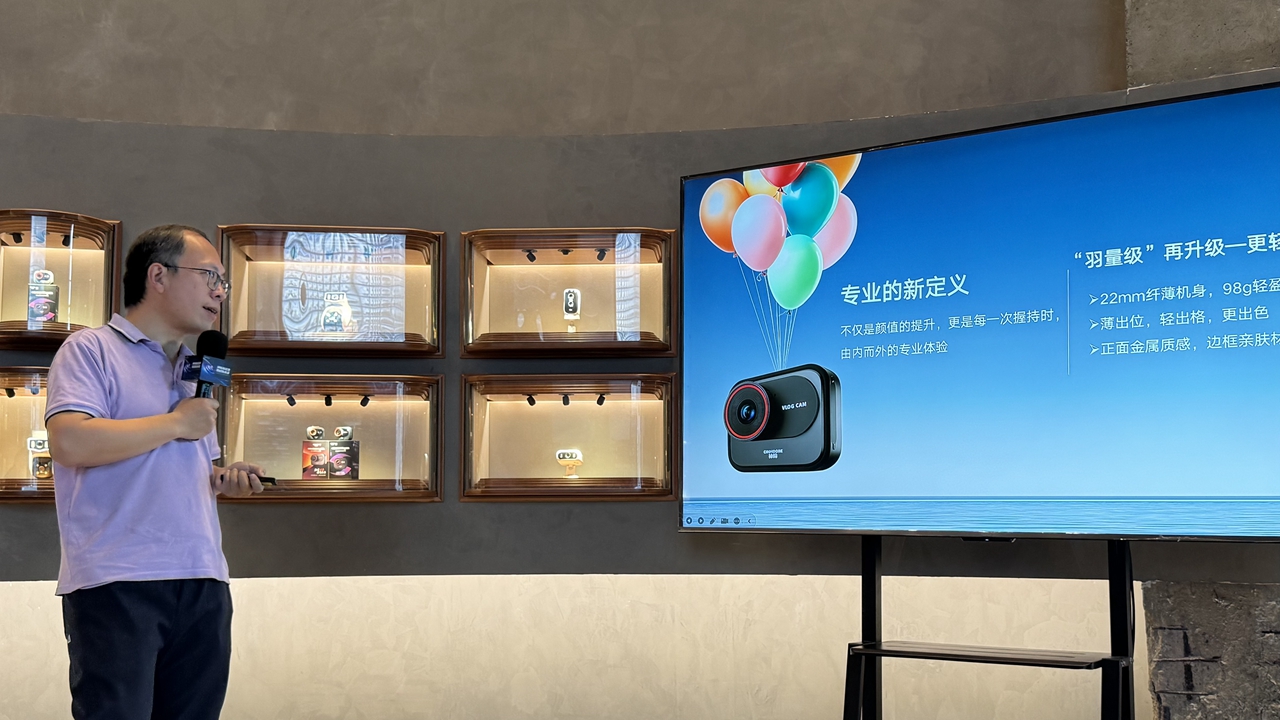 Bruce Deng, an engineer from SuperACME, speaks during a presentation at the conference. Photos by Shao Jingfeng
The company first integrates its own chips into CINMOORE-branded products, achieving immediate mass-production advantages.
Market feedback then fuels the next round of chip upgrades, creating a continuous loop of co-evolution between products and core chip technology.
Through this approach, CINMOORE aims to address a significant gap in the AIoT industry: the limited availability of high-performance, low-power chips optimized for edge-AI vision.
Challenges for fully autonomous core tech
In alignment with national priorities for secure and controllable core technologies, CINMOORE introduced its “Seven Extreme Challenges,” outlining ambitious performance targets for upcoming chip and device generations:
Extreme low power through self-developed chips and high-efficiency energy systems
Extreme imaging quality enabled by multi-camera synergy and intelligent zoom
Extreme stabilization supported by AI-enhanced anti-shake algorithms
Extreme compactness achieved with 3D stacking and high-density interconnects
Extreme intelligence through coordinated processing of large and small AI models
Extreme ease of use supported by full-scenario accessories
Extreme user value rooted in human-centric design
These breakthroughs, the company noted, will unlock wider adoption across urban governance, eldercare, public services, cultural tourism, emergency operations, and consumer content creation.
New products built on self-developed chips

A company staffer introduces a product to the visitors.
The conference also featured the debut of five new products, all powered by CINMOORE’s low-power AI vision chip platform and designed to form a multi-tiered product matrix for home security, outdoor monitoring, sports recording, and personal imaging:
BC7 Solar Battery Camera — A four-element system redefining outdoor security with ultra-low power use and integrated solar charging.
AOR Dual-Lens Battery PTZ Camera — Offers panoramic, PTZ, and close-up views simultaneously using dual-lens coordination.
BC4 Pro+ AI Dual-Lens Zoom Battery PTZ — Equipped with dual f/1.6 apertures, dual 4MP sensors, and 10× hybrid zoom for high-clarity, all-scenario monitoring.
V1 AI Smart Vlog Camera — A lightweight, portable camera delivering professional-grade content-creation features.
BC6V 4G Life-Record Camera — Tailored for long-duration activities such as marathons and cycling, providing hands-free, first-person recording.
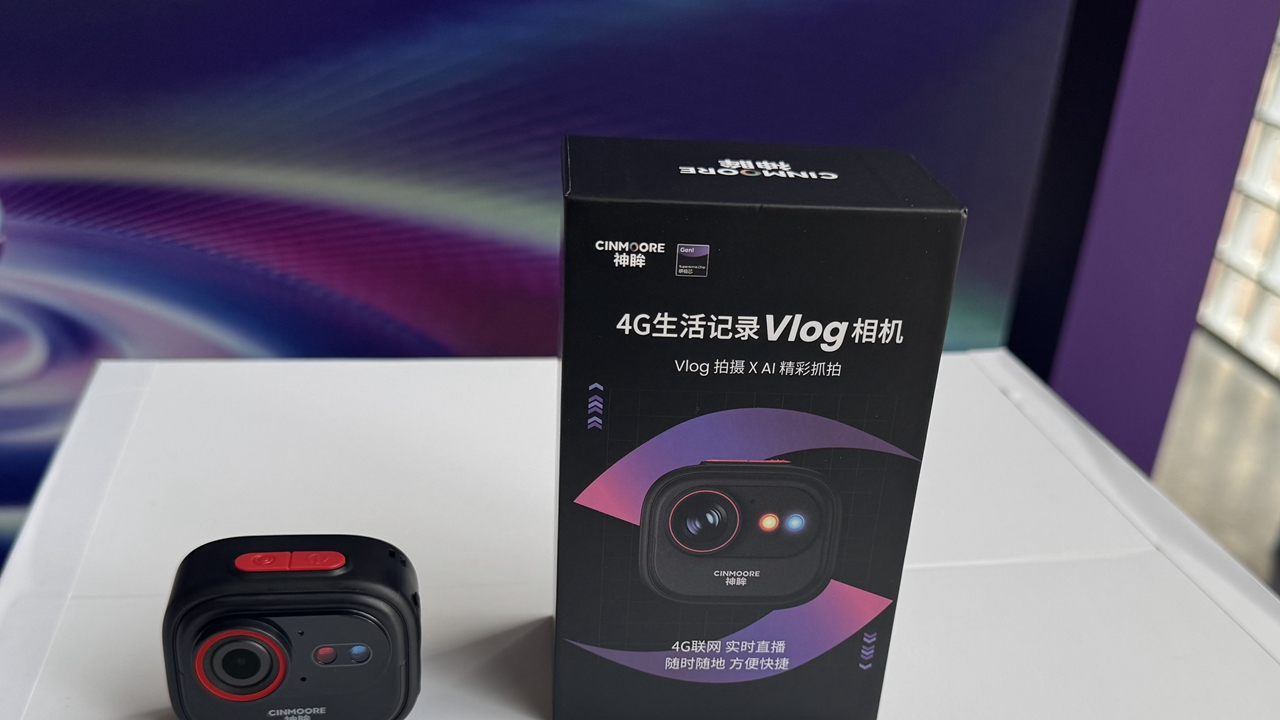
The BC6V 4G Life-Record Camera on show.
All devices adopt CINMOORE’s hallmark combination of low-power architecture, on-device AI recognition, and edge-cloud collaboration, reflecting the company’s belief that chip-level autonomy is the foundation of next-generation intelligent imaging.
Deng told the media that the company has launched an international expansion strategy. Its Amazon storefronts in both North and South America have officially launched, with the company focused on strengthening its presence in 4G-enabled, low-power imaging devices. By benchmarking leading global brands and deepening its expertise in niche categories, CINMOORE aims to position its self-developed chips as a key competitive advantage in overseas markets.
As China is accelerating the development of an AI innovation system and a secure, controllable smart-industry ecosystem, companies with independent chip R&D capabilities are expected to play an increasingly important role in smart imaging, urban governance, public services, cultural tourism, and consumer applications.
About SuperACME
SuperACME is a professional high-tech enterprise specializing in the R&D, production, and sales of integrated circuits and products for ultra-low-power computer-vision AI and intelligent video IoT applications. Headquartered in Hangzhou, the company operates R&D centers in Beijing, Shanghai, Shenzhen, Nanjing, Suzhou, Chengdu, and Xi’an.