
 Share
Share


 Print
PrintExhibition explores transformative work of ZHA
Writer: Cao Zhen | Editor: Lin Qiuying | From: Original | Updated: 2025-12-16
The “Architecture of Possibility: Zaha Hadid Architects” exhibition charts the evolution and progress of designs by one of the world’s most influential architecture studios of the past 50 years.
ZHA redefined architecture for the 21st century with a repertoire of projects that have captured imaginations across the globe. A journey of discovery into ZHA’s trailblazing architecture, the exhibition examines a series of chronological and thematic narratives that showcase ZHA’s pioneering, multidisciplinary research and design methodologies.
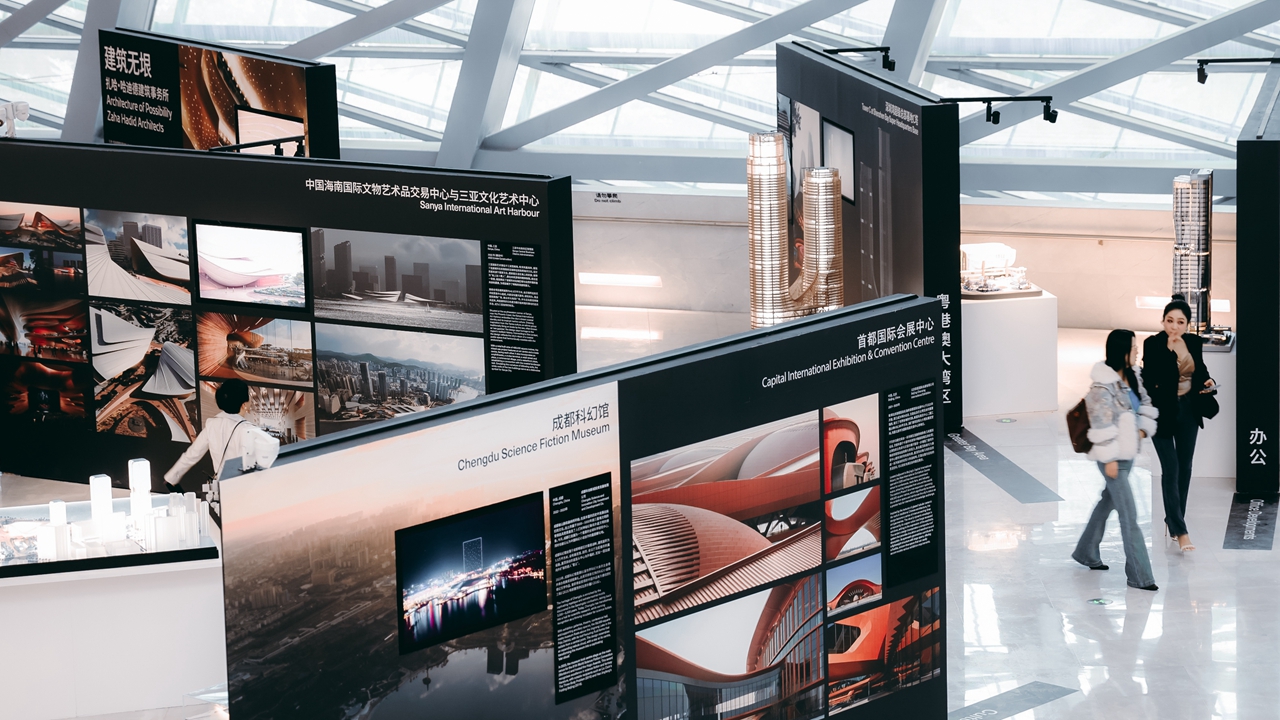
A glance at the “Architecture of Possibility: Zaha Hadid Architects” exhibition at Shenzhen Museum of Contemporary Art and Urban Planning. Photo courtesy of the organizers
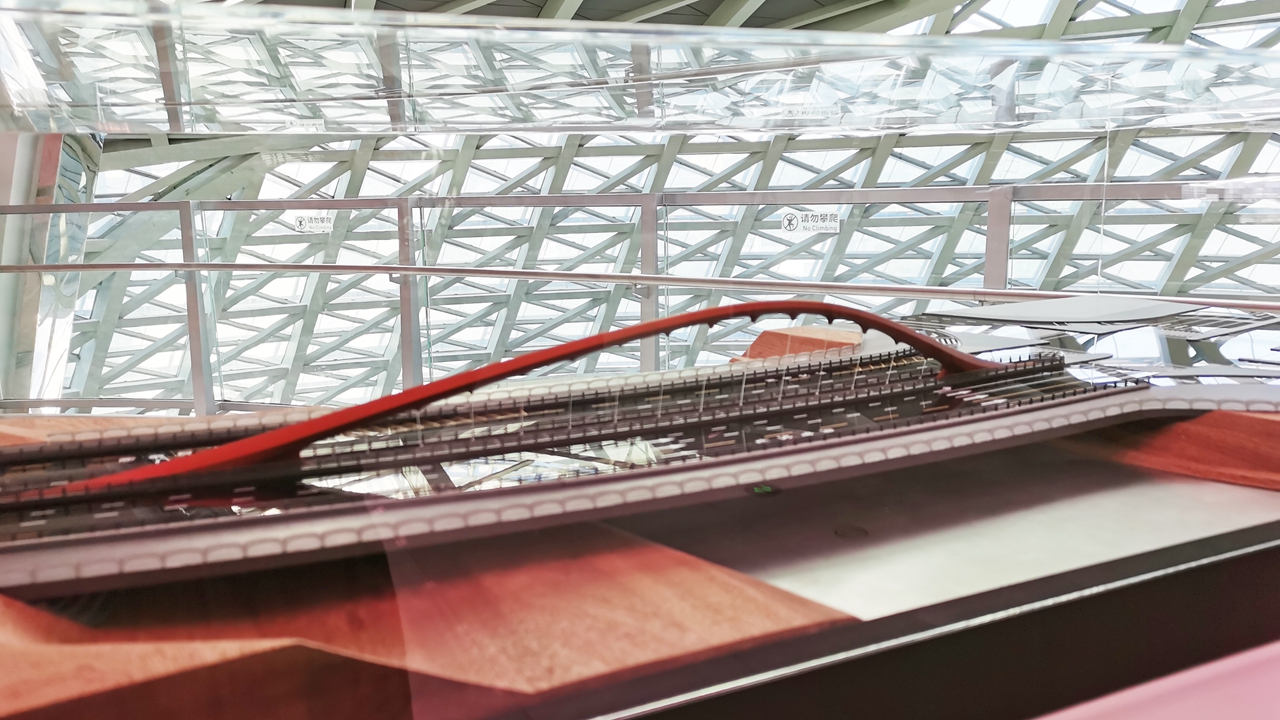
A model of Shenzhen Bridge No. 9 in Qianhai. Photos by Cao Zhen unless otherwise stated
This immersive exhibition investigates the remarkable transformation in the Guangdong-Hong Kong-Macao Greater Bay Area (GBA) and details ZHA’s commitment to China over five decades of globally acclaimed contributions to the development of the country’s architecture and urbanism.
An industry leader across the globe for half a century, ZHA’s ongoing advancement of architectural design through research, technology and creativity mirrors the GBA’s position as a center of excellence for innovation, connectivity and sustainability.
With over 25 built and ongoing projects in the GBA — including more than 15 extraordinary buildings currently under construction — ZHA’s work demonstrates the practice’s longstanding engagement with the region’s dynamic cultural environment to develop the smart sustainable cities of tomorrow.
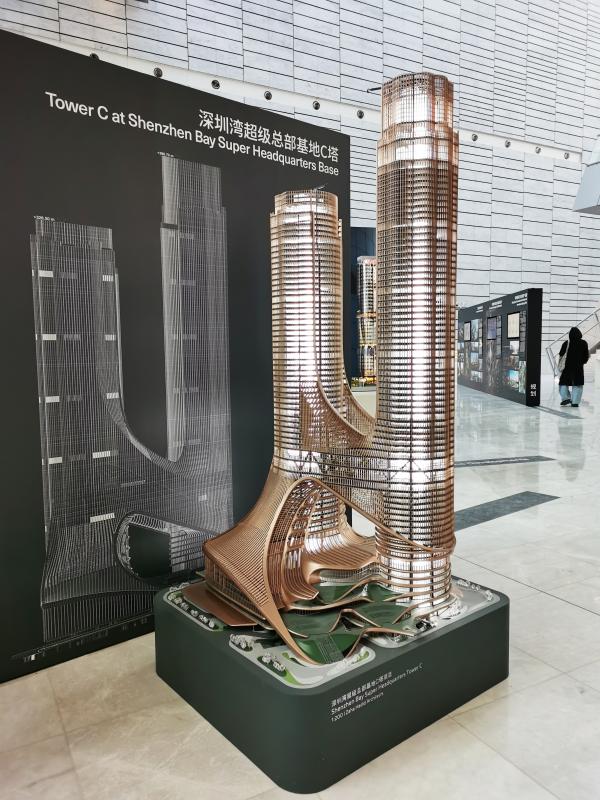
A model of Tower C at Shenzhen Bay Super Headquarters Base.
Mathematicians equate the fluid geometries of ZHA’s architecture to the beauty and coherence evident within the natural world’s systems and structures, but beyond the mathematical formulas and equations, the expressive fluidity and meticulous attention to detail within ZHA’s architecture engages the senses and captures the eye. For all their mystification of forms and remarkable ability to evoke our emotions, ZHA’s buildings remain clearly organized and intuitive to navigate.
Encompassing award-winning projects throughout the GBA have been acknowledged across the globe for its virtuosity, ZHA’s works in the region include the Shenzhen Science & Technology Museum, The Henderson tower in Hong Kong, and Morpheus Hotel in Macao which have reinvented our concepts of space.
Continuing this trajectory into the future, ZHA’s seminal designs for the Shenzhen Institute for Financial Technology, Tower C at Shenzhen Bay Super Headquarters Base, and the High Speed Rail West Kowloon Terminus Development in Hong Kong are currently in development.
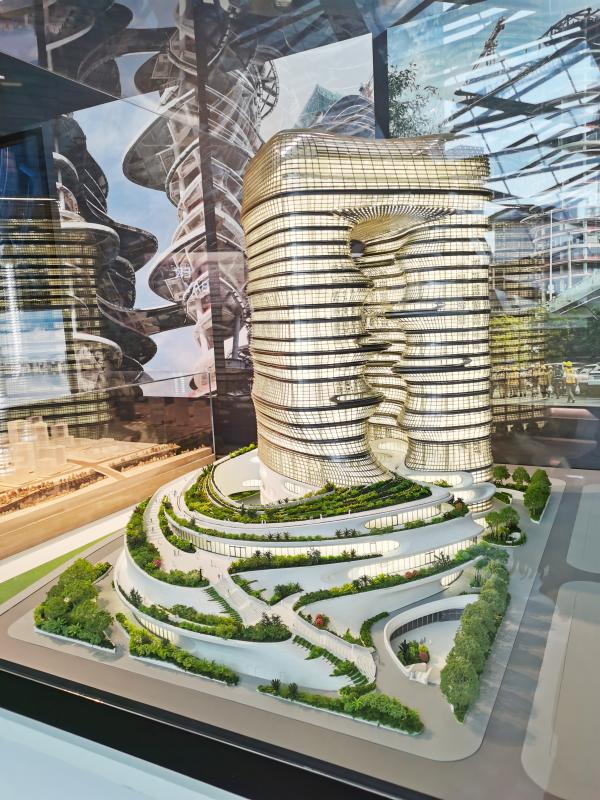
A model of Yidan Center.
ZHA’s buildings enrich the cultural fabric of a city, providing gathering places that anchor our sense of identity and civic pride. Projects including the new Greater Bay Area Sports Center in Guangzhou and GO PARK Sai Sha in Hong Kong embody the spirit and aspirations of their communities, while the upcoming Yidan Center in Shenzhen has been designed by ZHA for the Chen Yidan Foundation to provide a nurturing environment that will cultivate and support lifelong learning.
Exploring the evolution of ZHA’s visionary architecture at the cutting-edge of the profession, the exhibition examines the studio’s pioneering advancement of artificial intelligence (AI), immersive and interactive design, and virtual spaces that are integral to ZHA’s rapidly evolving design ecosystem.
Collaborative research with world leaders in AI computing plays an important role in the development of ZHA’s work. The analytical power, speed and precision of AI, machine learning and data-driven digital technologies are enabling ZHA to analyze and explore myriad permutations of complex geometrical, environmental and behavioral models that inform design decisions and liberate creativity. The practice continues to develop these AI applications, offering exponential opportunities to enrich the firm’s architecture and urbanism.
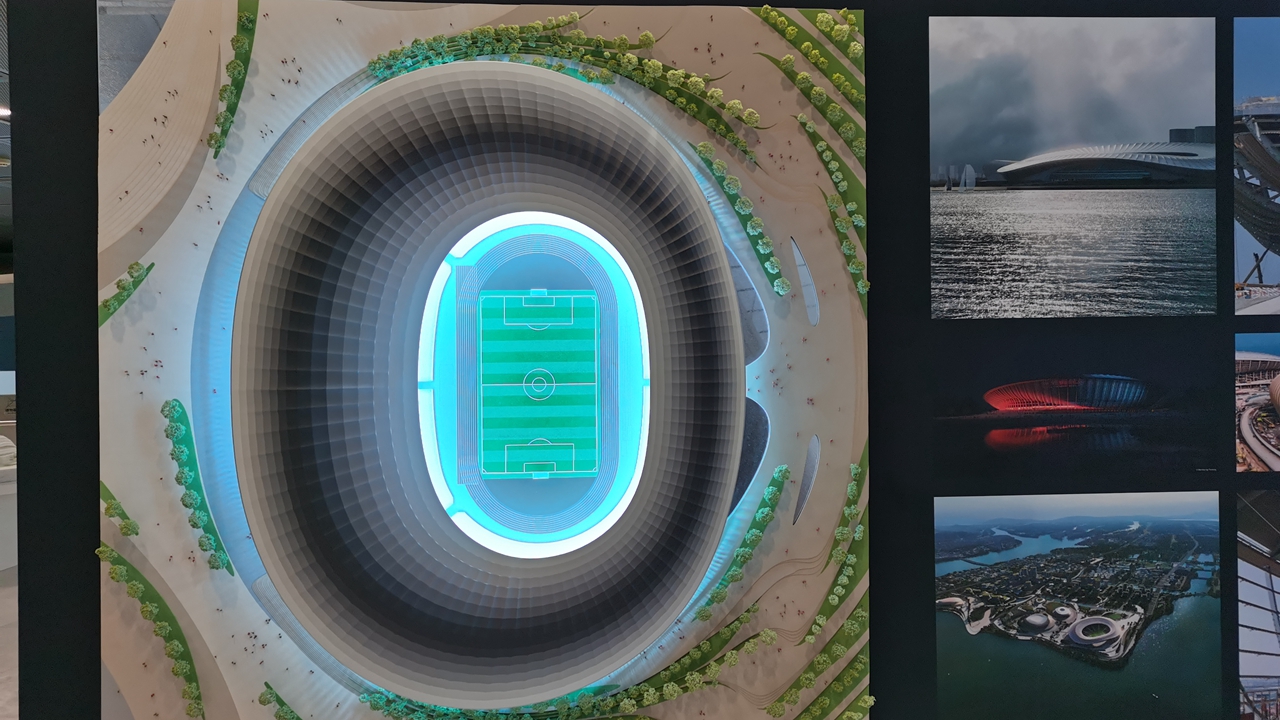
A model of Greater Bay Area Sports Center in Guangzhou.
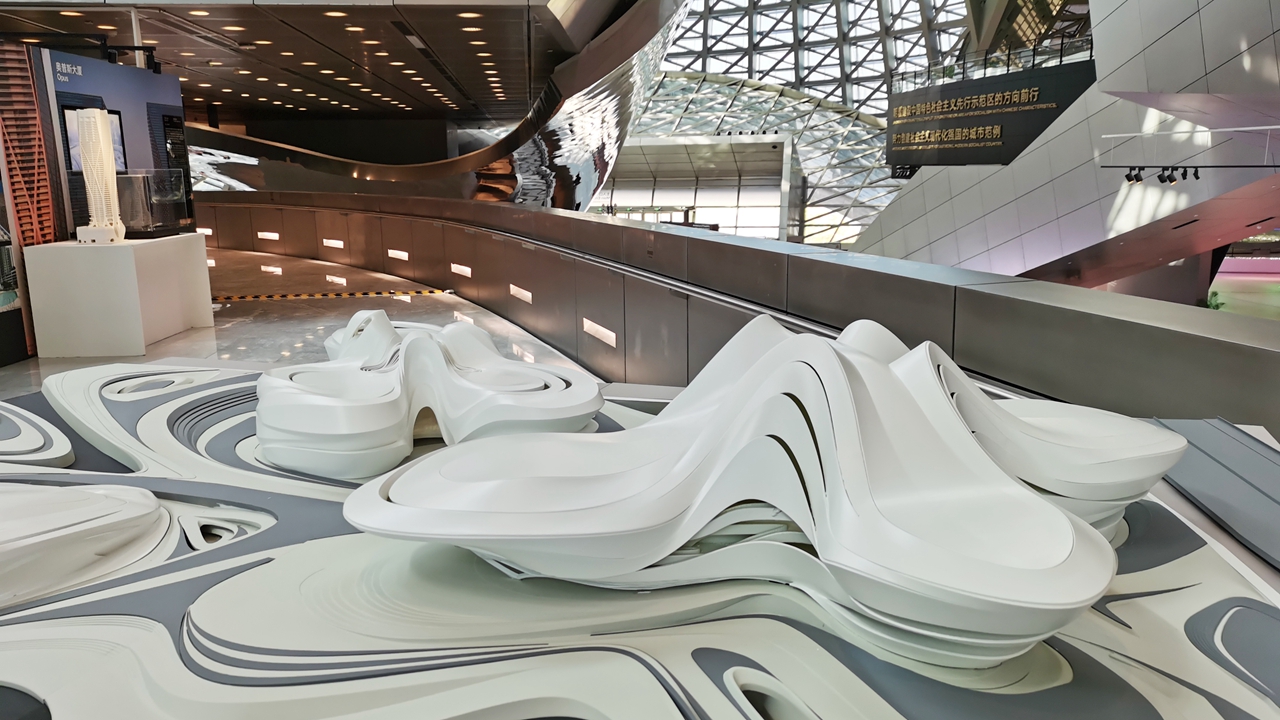
A model of Changsha Meixihu International Cultural Center.
Cyberspaces and metaverse environments are sophisticated digital platforms using state-of-the-art video gaming technologies enabling the virtual exploration and configuration of space. These advanced digital tools integrate 3D computer models of ZHA’s projects with virtual reality (VR), enabling their architects to be immersed within the spaces they are designing and walk-through design proposals in VR and in real-time with clients, stakeholders and end-users.
Investigating ZHA’s development of these new technologies that are transforming the work of 21st century architects, five zones within the exhibition (“ZHA City: Greater Bay Area District,” “Metrotopia,” “Brainstorming,” “Interactive Plan Configurator” and “Exhibition Digital Twin”) present the studio’s explorations of cybernetic architecture that is rapidly enhancing our interactions between the physical and virtual worlds.
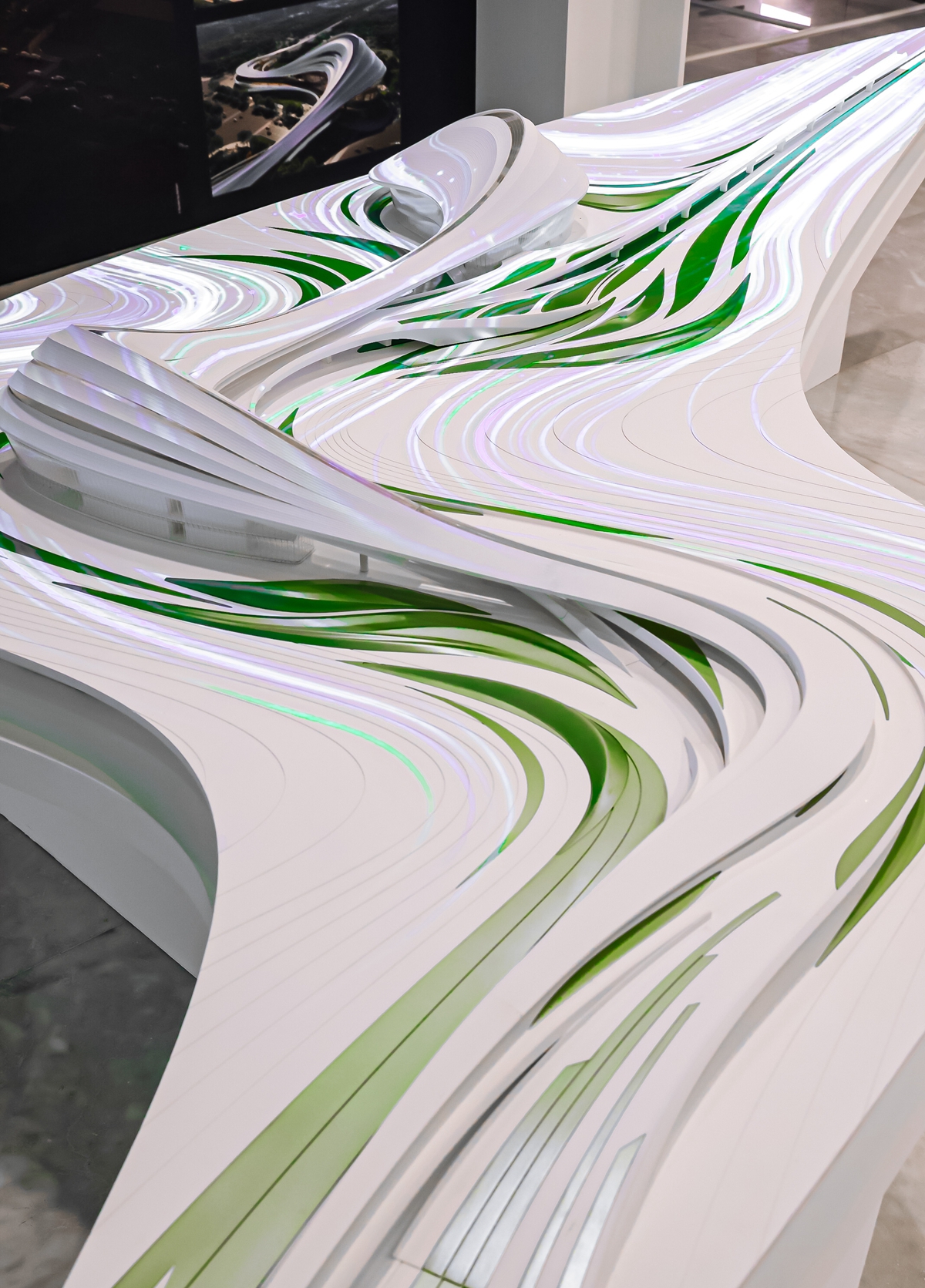
A model of Jinghe New City Culture and Art Center in Xi’an. Photo courtesy of the organizers
Robotics and Digital Fabrication (RDF) techniques and the use of Architectural Geometries (AG) are changing how we design and construct. ZHA’s RDF research presented within the exhibition details the practices’ collaborations with innovative industry disruptors to create unprecedented digital design models that are in constant dialogue with agile industrial robots to perform precise fabrication processes.
Dates: Through April 10, 2026
Venue: Shenzhen Museum of Contemporary Art and Urban Planning, Futian District (深圳市当代艺术与城市规划馆)
Metro: Line 3 or 4 to Children’s Palace Station (少年宫站), Exit A2