
 Share
Share


 Print
PrintEx-OpenAI researcher makes first public appearance since joining Tencent
Writer: Yu Yuanfan | Editor: Lin Qiuying | From: Original | Updated: 2026-01-12
“Recently I’ve been busy building models and products. It feels great to be back in China.”
Yao Shunyu, a former OpenAI researcher and now chief AI scientist in Tencent’s CEO/President Office, made his first public appearance since taking up the position at the AGI‑Next Summit on Jan. 10.
Born in 1998, Yao graduated from China’s prestigious Tsinghua University’s Yao Class and Princeton University before joining OpenAI in 2024. As a core researcher on the team, he focused on developing AI agents.
In May 2025, Yao was named in MIT Technology Review’s “35 Innovators under 35” China List, becoming its youngest honoree. In December, Shenzhen-based Tencent announced that it had appointed him chief AI scientist in the Office of the CEO and President. He will report directly to president Martin Lau.
Yao also heads Technology Engineering Group’s AI Infra and LLM departments and reports to the group’s president Lu Shan.
Clear model divergence between To-C and To-B markets
In his first public remarks since joining Tencent, Yao said that two major forms of model divergence are becoming increasingly apparent. First, there is a clear split between consumer-facing (To-C) and enterprise-facing (To-B) models. Second, differences are emerging in vertical integration strategies and in how models are layered with applications.
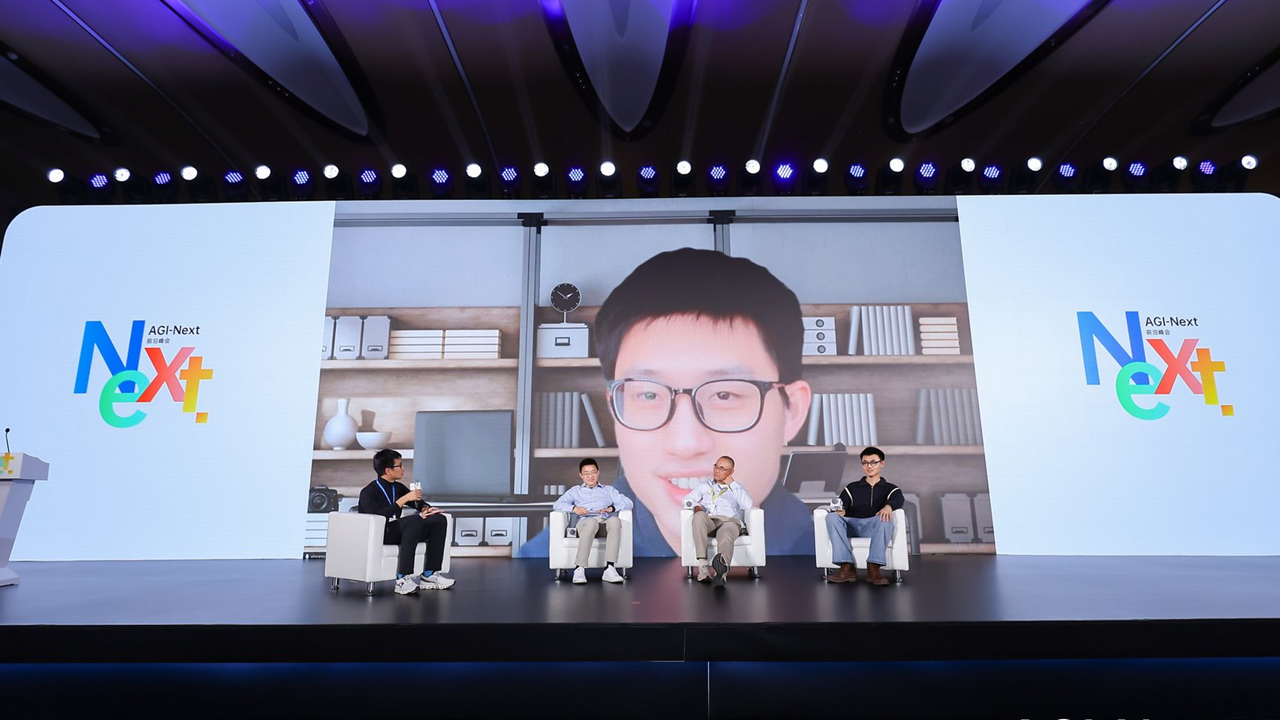
Photo from WeChat official account "深视新闻"
Using ChatGPT as an example, he said that for most consumers, high-level intelligence is not always necessary and many users do not perceive significant improvements compared with a year ago. By contrast, in enterprise scenarios, higher intelligence typically yields higher productivity. He predicted that in the enterprise market, the performance gap between leading models and slightly weaker alternatives will continue to widen.
He also emphasized that the capabilities required at the model layer are fundamentally different from those at the application layer. In enterprise and productivity-focused scenarios, larger-scale pre-training is especially critical.
Yao described Tencent as a company with a strong consumer-facing DNA.
“We think about how today’s large models — or the broader development of AI — can deliver greater value to users,” he said.
Agent development in To-B scenarios not slowing
Yao believes that the development of AI agents in enterprise scenarios is going upward, with no indication of slowing down.
“As long as pre-training continues to scale, and post-training keeps improving performance on real-world tasks, agents will become increasingly intelligent — and that will translate into growing value,” he said.
When asked how agents can generate real economic value, Yao said the bottleneck often lies not in the models themselves, but in the environment and education.
Drawing on his experience as an intern at Scale AI, he said that even without further improvements in model capability, simply deploying existing models across diverse enterprise environments can already create substantial economic value.
“Education is extremely important,” he said. “The gap between people is widening — not because AI is replacing jobs, but because people who know how to use tools are replacing those who don’t.”
In Yao’s view, one of the most meaningful tasks in China today is educating the public to use AI tools more effectively, thereby closing this cognitive gap.
Chinese AI teams could reach the global top tier
Yao is optimistic that a Chinese AI company could join the global top tier within three to five years, noting that China has already proven strengths in technological replication and localized optimization in industries such as manufacturing and electric vehicles.
He identified three major challenges that Chinese AI teams still face: bottlenecks in compute and chip-related technologies such as lithography machines, the relative immaturity and limited internationalization of the enterprise market and, perhaps most importantly, the cultivation of a culture that embraces risk-taking and supports frontier research.
As for where the next paradigm-shifting innovation might emerge, Yao says OpenAI is still the most likely candidate. Despite the impact of commercialization on its innovation DNA, the company’s fundamental advantages remain intact.