
 Share
Share


 Print
PrintRUCKUS hackathon at Avenues Shenzhen sparks student innovation
Writer: Chang Zhipeng | Editor: Lin Qiuying | From: Original | Updated: 2026-03-09
How can technology help people combat loneliness? Forty-four students from China and the U.S. set out to answer that question.
From March 6 to 8, RUCKUS — a 43-hour design hackathon for Avenues Shenzhen students in Grades 5 to 12 — wrapped up at Avenues Shenzhen. Participants came from the school’s Shenzhen and New York campuses, Adream School and open registration. Working non-stop, they explored tech-based solutions to the global challenge of loneliness.
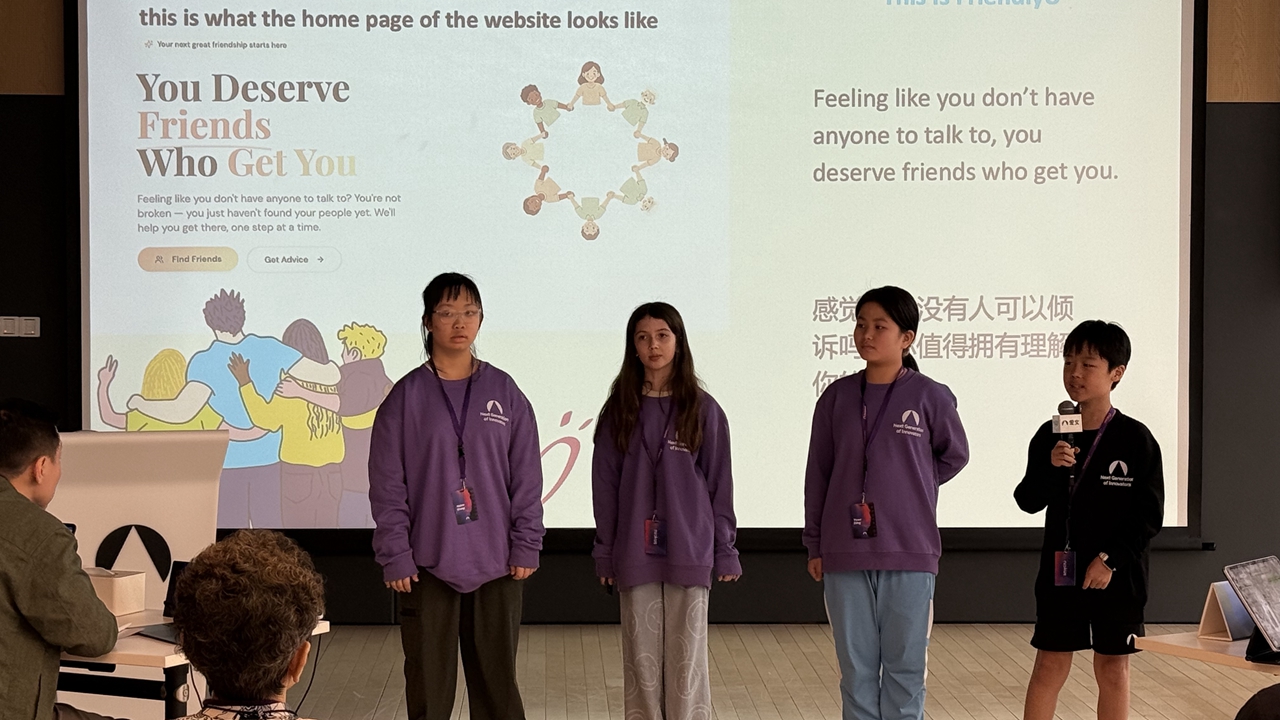 A team delivers its final project presentation at the wrap-up event at Avenues Shenzhen on Sunday. Photos by Chang Zhipeng
With loneliness a growing social issue worldwide, RUCKUS encouraged an interdisciplinary approach that blended technology, the humanities and social perspectives to rethink relationships and the future of social connection.
Over the course of the event, the 44 students formed 11 mixed teams spanning nationalities, schools and grade levels. Guided by mentors and industry experts, teams followed the full innovation cycle: observing the problem, brainstorming ideas, building prototypes and delivering final presentations.
Mentors and judges included specialists in digital product design, startup modeling, community governance and investment. Those interactions gave students deeper insight into real-world complexity while sharpening their critical thinking, communication and innovation skills.
Prizes were awarded for Best Technical Implementation, Best Humanistic Impact, Best Feasibility Potential and Best Project Presentation. Each winning team received 10,000 yuan (about US$1,446).
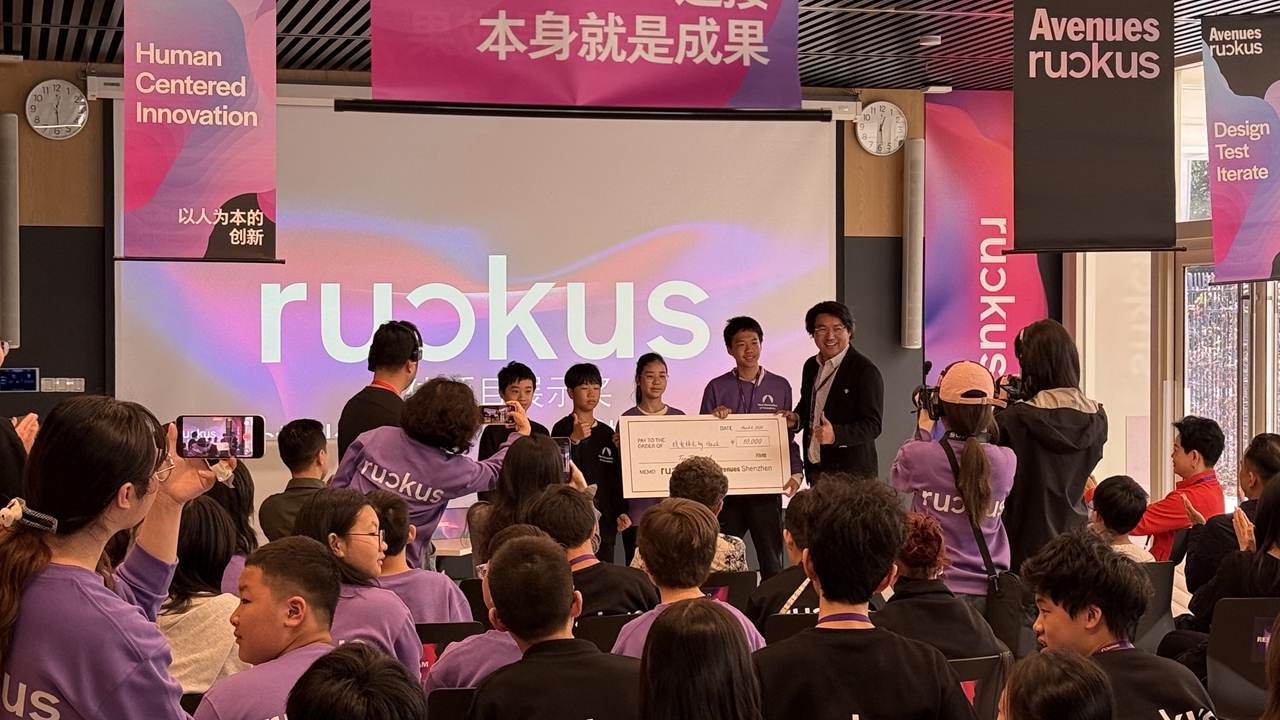
A winning team collects its prize money.
The RESONA Resonance AI project won Best Technical Implementation. Using an AI digital-twin model, it aims to help users more efficiently find conversational matches and improve the quality and depth of social connections. TalkItOut won Best Feasibility Potential. Designed for adolescents and young adults struggling with loneliness, it offers conversational-practice features that let users rehearse expressing themselves in simulated dialogues and learn through trial and error.
RUCKUS was more than an international student competition — it was a cross-regional, cross-cultural exchange rooted in equal dialogue. Students from New York, Shenzhen, Guangzhou and Lichuan in Hubei Province worked side-by-side, bringing diverse backgrounds and perspectives and discovering new possibilities. The experience exposed participants to multicultural realities and deepened their sense of social responsibility.