
 Share
Share


 Print
PrintSanitation robots give workers a break in Pingshan
Writer: | Editor: Lin Qiuying | From: Shenzhen Daily | Updated: 2025-12-05
Shenzhen Cowa Robot has deployed 36 automated cleaning machines across an area of 2.7 million square meters in Shijing Subdistrict, Pingshan District. These robots have already been quietly cleaning sidewalks, street corners, and roads for some time, according to a company staffer.
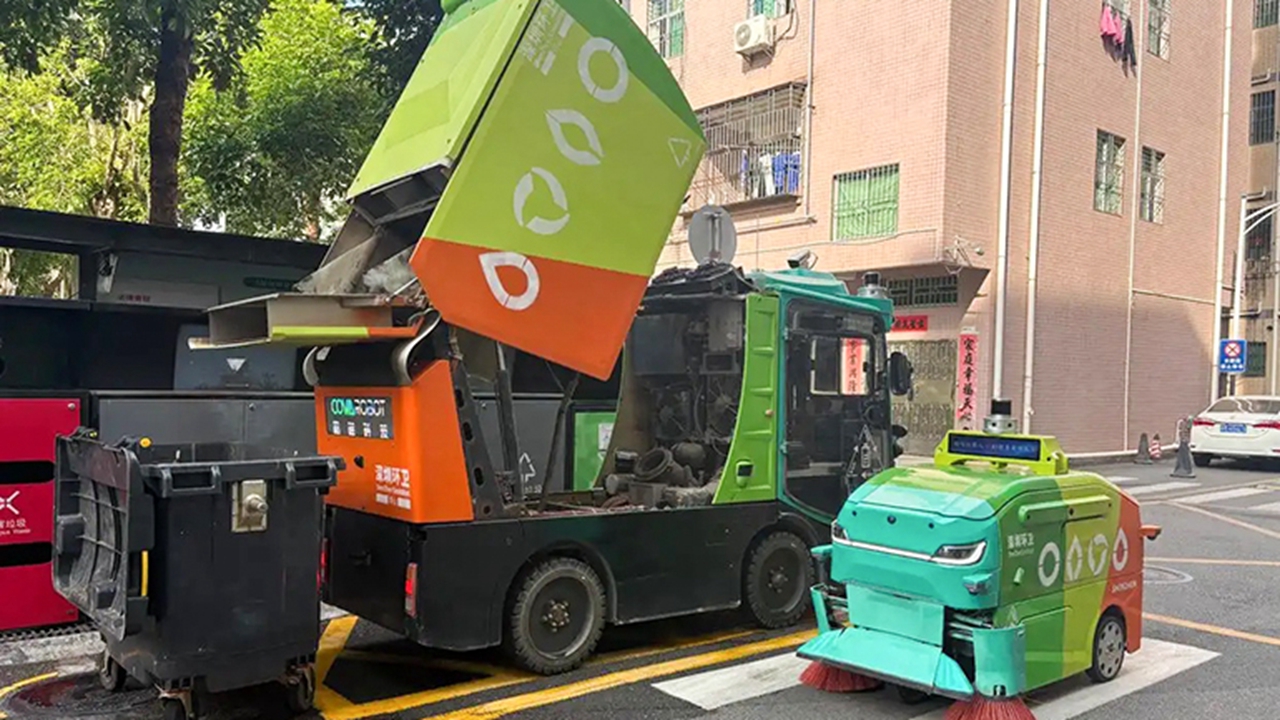
A Cowa sanitary robot is seen working at a garbage transition station in Shijing Subdistrict, Pingshan District in this file photo. SD-Agencies
The technology behind them, however, is far from simple. “Garbage is not uniformly definable — it has no fixed shape or stable boundaries,” explained Cowa’s executive president, Wang Yu. This places high demands on the generalization ability of the robots’ AI models.
Training with real-world data to identify trash is just the first step, Wang noted. The complexity of real environments adds further challenges, as robots must also decide how to handle different types of waste, from fallen leaves to chewing gum.
The push for automation is driven in part by municipal goals. Shenzhen aims to reduce manual labor by three to five workers for each robot deployed, with strict performance assessments. Given that the annual cost of a sanitation worker in Shenzhen is around 70,000 yuan (US$9,870), deploying a robot becomes economically viable if its yearly operating cost stays under 200,000 yuan.
Cowa’s primary clients are local governments, but the company is also looking abroad, with plans to explore markets in Singapore and trial their robots in Abu Dhabi.
Despite the efficiency gains — where one worker with a robot can now maintain 7–8 km of sidewalk per day, compared to 1 km manually before — the goal is not full replacement. “We aim for human-robot collaboration,” said Cowa CTO Liao Wenlong.
This shifts human roles away from repetitive sweeping toward supervision, assistance, and handling more complex tasks that robots cannot yet manage, such as cleaning inside shrubs, removing bin residues, or taking down wall posters.
In this shift, robots are not just taking over — they’re giving workers a break from the grind, while redefining what their jobs can be.