
 Share
Share


 Print
PrintExperts converge in Guangming to chart future of scientific infrastructures
Writer: Windy Shao | Editor: Lin Qiuying | From: Original | Updated: 2025-12-05
The Forum on Major Scientific Infrastructure Planning and Collaborative Operations, a parallel session of the Guangming Science City Forum, was held Dec. 5 at Guangming Life Science Park.
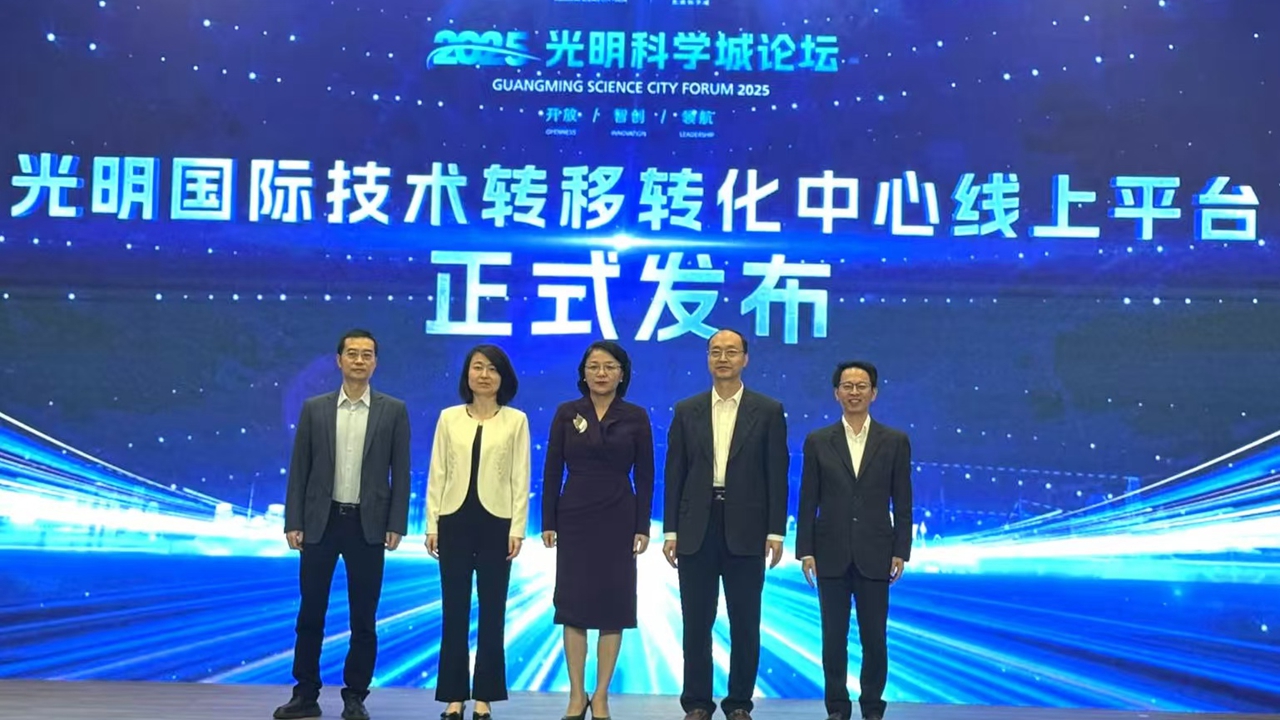
The launch ceremony of the online platform for the Guangming International Technology Transfer and Transformation Center. Photos by Shao Jingfeng
Hosted by Guangming Science City Development and Construction Co. Ltd., the forum brought together nearly 300 representatives from government departments, science city management bodies, enterprises, universities, research institutes, and investment institutions.
The open forum session featured a collective signing ceremony with facility users, alongside the official launch of the online platform for the Guangming International Technology Transfer and Transformation Center. The dual events marked Guangming Science City’s full transition into the operational phase of its major scientific infrastructures.
Guangming Science City has already completed and put into operation several major facilities — including the Synthetic Biology Infrastructure, Brain Science Infrastructure, Materials Genome Infrastructure, and the Guangming Life Science Big Data Center.
During the user signing ceremony, organizations such as the Shenzhen Institutes of Advanced Technology, CAS, the research team of Prof. Liu Xiaofan at City University of Hong Kong, and the Guangming District Industry and Information Technology Bureau (Overseas Talent Station) signed cooperation agreements with the science city company. The partnerships will improve facility utilization efficiency while ensuring research access.
The forum witnessed the official launch of the online platform for the Guangming International Technology Transfer and Transformation Center — the central “command hub” for technology commercialization in Guangming Science City.
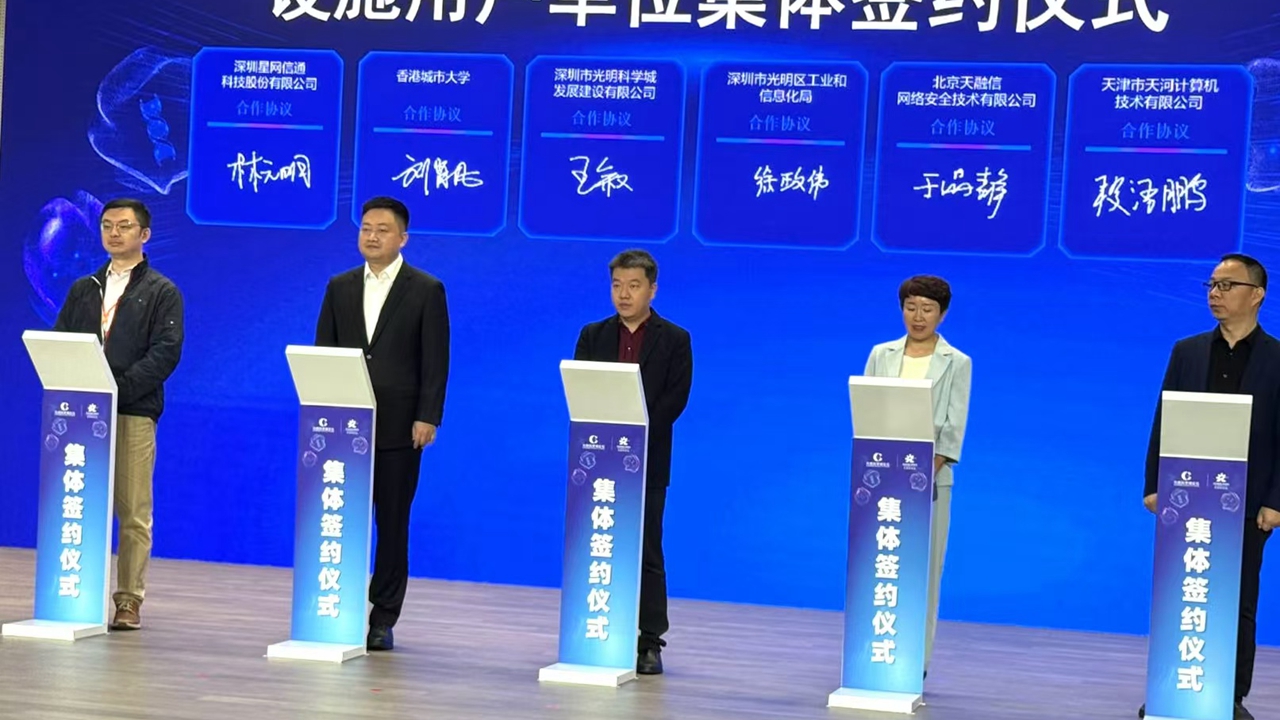
The signing ceremony with facility users.
Featuring eight functional centers and 30 AI-powered tools, the platform enhances accuracy and efficiency of resource matching, supports researchers in planning commercialization pathways, and helps enterprises reduce R&D costs. By accurately aligning achievements, demands, talent, and policies, the platform aims to accelerate technology commercializationand strengthen the science city’s influence as a global innovation center.
Experts gather to share insights
The forum invited renowned experts from China and abroad to share insights on topics ranging from spatial planning of science ecosystems to AI, biotechnology, remote sensing satellites, and anti-fraud technologies.
Prof. Lyu Bin from Peking University’s College of Urban and Environmental Sciences delivered a keynote speech titled “Planning Practices for Science and Technology Ecosystems Driven by Major Scientific Infrastructures.” He analyzed representative global cases, illustrating how strategic layout of major facilities and optimized integration of research, industry, and urban functions can foster efficient innovation ecosystems and support regional sustainable development.
Liu Mingju, vice president of ICT BG Marketing & Solution Sales at Huawei, presented “Intelligent World 2035: Decoding Ten Future Technology Trends.” She outlined how the digital and physical worlds are rapidly converging, driven by data, intelligent technologies, computing power, network capabilities, and new energy. She also highlighted the emerging trends that will guide the evolution of next-generation technology infrastructure.
Liu Xiaofan, associate professor at City University of Hong Kong, shared insights in his talk “Enhancing Anti-Fraud Capabilities Through AI and Social Science Theories.” He introduced the university’s multidimensional initiative to build a system that integrates technical innovation with psychological and sociological approaches.
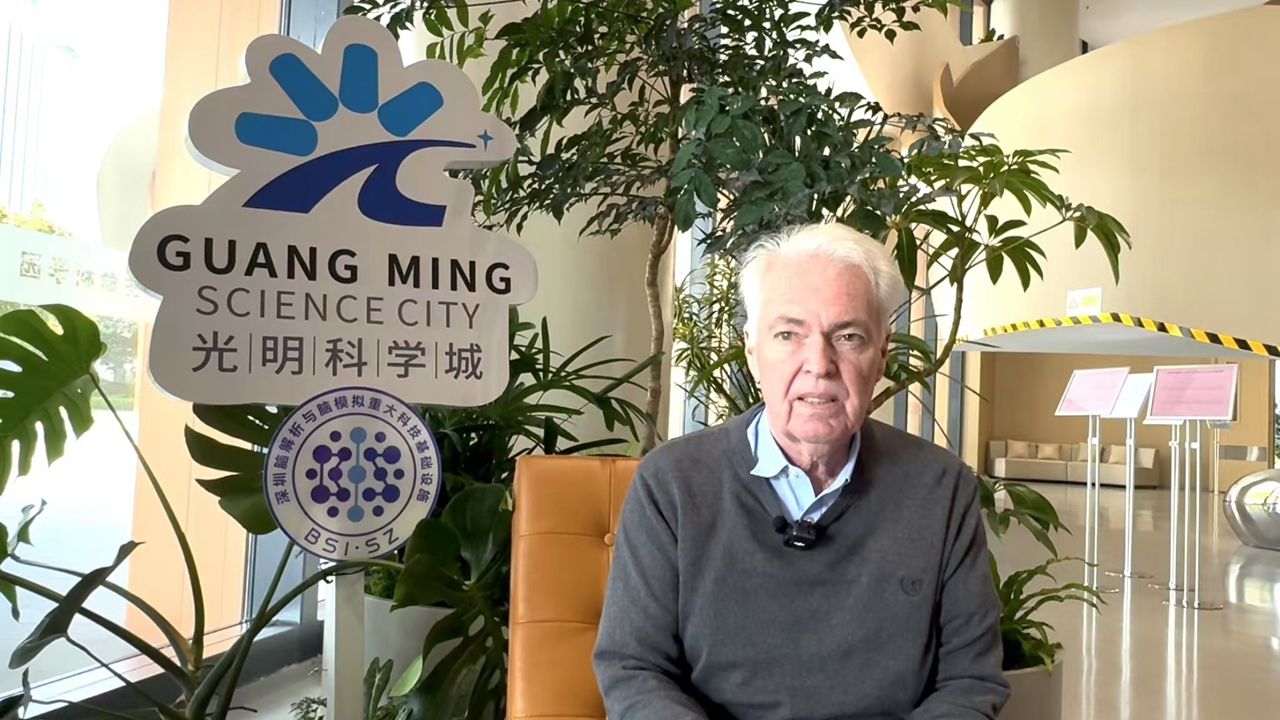
Prof. Helmut Kettenmann during an interview with Shenzhen Daily.
Prof. Helmut Kettenmann from the Shenzhen University of Advanced Technology told Shenzhen Daily that his team has been cooperating with the Brain Science Infrastructure for a year. A leading German neuroscientist, he is widely recognized as one of the world’s most influential pioneers in glial cell research.
He said the facilities in Guangming are excellent and that his team greatly enjoys working in such an outstanding environment.
“There used to be a trend of talented Chinese researchers going abroad, but now it’s time to reverse that trend,” Kettenmann said, adding that Guangming Science City is well positioned to attract more international talent with its innovative ecosystem.