
 Share
Share


 Print
PrintRare 'Blood Moon' to face rainy Lantern Festival duel in Shenzhen
Writer: Song Yingwen | Editor: Zhang Chanwen | From: Shenzhen Daily | Updated: 2026-03-03
Tonight, the Lantern Festival offers more than just traditional sweet dumplings and lanterns. The sky is set to host a rare "Blood Moon" total lunar eclipse, though a stubborn weather front over Shenzhen threatens to shroud the spectacle in clouds and rain.
While 2026 features four eclipses globally, tonight marks the arrival of the undisputed "crown jewel" for China. Experts at the Beijing Planetarium have designated this the year’s premier astronomical phenomenon, as it is the only eclipse of any kind visible nationwide this year.
Adding to its historic nature, the total lunar eclipse aligns perfectly with the 15th day of the lunar new year — a rare coincidence for the year's most symbolic full moon.
Despite the significance, latest meteorological data suggests Shenzhen residents will need as much luck as they do equipment to catch a glimpse.
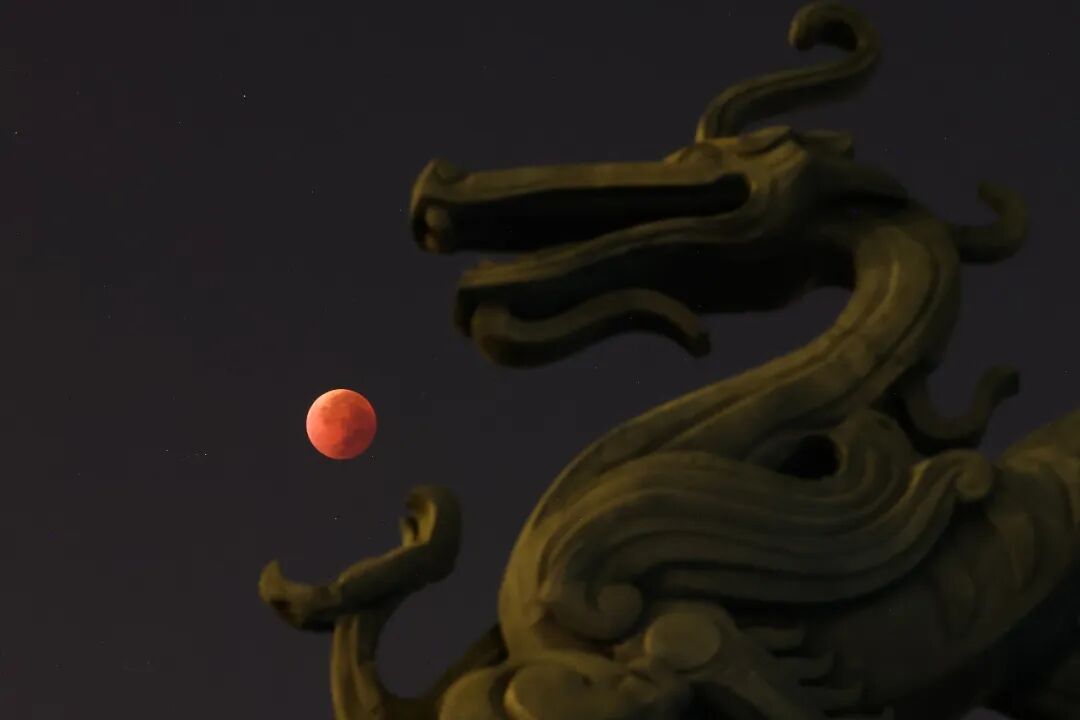
A deep crimson "Blood Moon" hangs over the night sky in Nanjing, Jiangsu Province, during the total lunar eclipse on Sept. 8, 2025. The stunning hue is caused by Earth's atmosphere scattering sunlight and reflecting only the red wavelengths onto the lunar surface. China News Service
A "moonrise in eclipse"
The eclipse officially begins its "initial contact" (初亏) at 5:49 p.m. Because the moon does not rise over Shenzhen until approximately 6:22 p.m., the orb will already be partially obscured as it clears the horizon — a phenomenon known as "eclipsed moonrise."
The most critical phases of the night follow a strict timeline:
7:04 p.m. (Totality begins): The moon enters the Earth’s full shadow, turning a deep copper red.
7:33 p.m. (Maximum eclipse): The "Blood Moon" reaches its darkest and most vibrant state.
8:02 p.m. (Totality ends): The moon begins to regain its pearly white glow.
9:17 p.m. (Full recovery): The eclipse concludes as the moon returns to a full, brilliant circle.

This chart illustrates the trajectory of tonight’s total lunar eclipse over the Shenzhen skyline. While the eclipse begins earlier in the afternoon, the moon will rise in Shenzhen at 6:22 p.m. already partially obscured, reaching its iconic "Blood Moon" state (totality) between 7:04 p.m. and 8:02 p.m. Courtesy of WeChat mini program "天文通"
Hourly forecast: A dampener on the festivities
However, a newly released hourly data from the Shenzhen Meteorological Bureau paints a challenging picture for stargazers. A persistent weather system is expected to keep the city under a blanket of rain throughout the entire duration of the eclipse.

An hourly weather chart from 1 p.m.-10 p.m. tonight. Shenzhen Shenzhen Meteorological Bureau
The hourly breakdown shows a 100% consistency of showers during the peak viewing window:
6 p.m.-7 p.m.: As the moon rises, temperatures will hover at 17°C with steady rain and Level 2 northerly winds.
7 p.m.-9 p.m. (The peak): During the total eclipse phases, temperatures will drop to a chilly 16°C. Showers are forecast to continue, accompanied by Level 3 north-easterly gusts.
9 p.m.-10 p.m.: Even as the moon recovers, the rain is expected to persist, making outdoor celebrations significantly cooler and wetter.
Viewing strategy
Despite the grim forecast, veteran observers note that "gaps in the clouds" can often occur during rain showers. Those determined to see the event should prioritize locations with an unobstructed view of the eastern horizon, such as Shenzhen Bay Park in Nanshan, Xichong in Dapeng, or Mount Tanglang in Nanshan.
"Because the moon remains low in the sky — less than 9 degrees during the start of totality — it offers a unique chance to photograph the red moon against the city's architectural landmarks," astronomy experts noted.
Due to the forecast of 16°C temperatures and high humidity (80%-98%), residents are advised to wear thermal layers and bring sturdy umbrellas if heading outdoors.
For many, this represents a final chance for a decade; the next total lunar eclipse to coincide with the Lantern Festival will not occur until February 2036.