
 Share
Share


 Print
PrintChina unveils major development targets for 2026-2030
Writer: | Editor: Lin Qiuying | From: | Updated: 2026-03-06
China has set its economic growth target at 4.5% to 5% for 2026 and will "strive for better in practice," according to a government work report submitted yesterday to the country's top legislature.
As the nation enters the inaugural year of its 15th Five-Year Plan (2026-2030), the report balances immediate socio-economic stability with long-term technological transformation.
 The opening meeting of the fourth session of the 14th National People's Congress is held at the Great Hall of the People in Beijing yesterday. China News Service
2026: Balancing stability and employment
For the 2026 fiscal year, the government has outlined a robust framework to maintain economic momentum and social welfare. The primary targets include:
Economic growth: A GDP growth target of 4.5% to 5%.
Employment: Over 12 million new urban jobs, with a surveyed urban unemployment rate maintained at around 5.5%.
Inflation control: An increase in the consumer price index (CPI) of around 2%.
Income alignment: Growth in personal income to move in step with overall economic growth. Achieving a basic equilibrium in the balance of payments.
Food Security: Maintaining a grain output of approximately 700 million tonnes.
Environmental targets: A drop of around 3.8% in carbon dioxide emissions per unit of GDP.
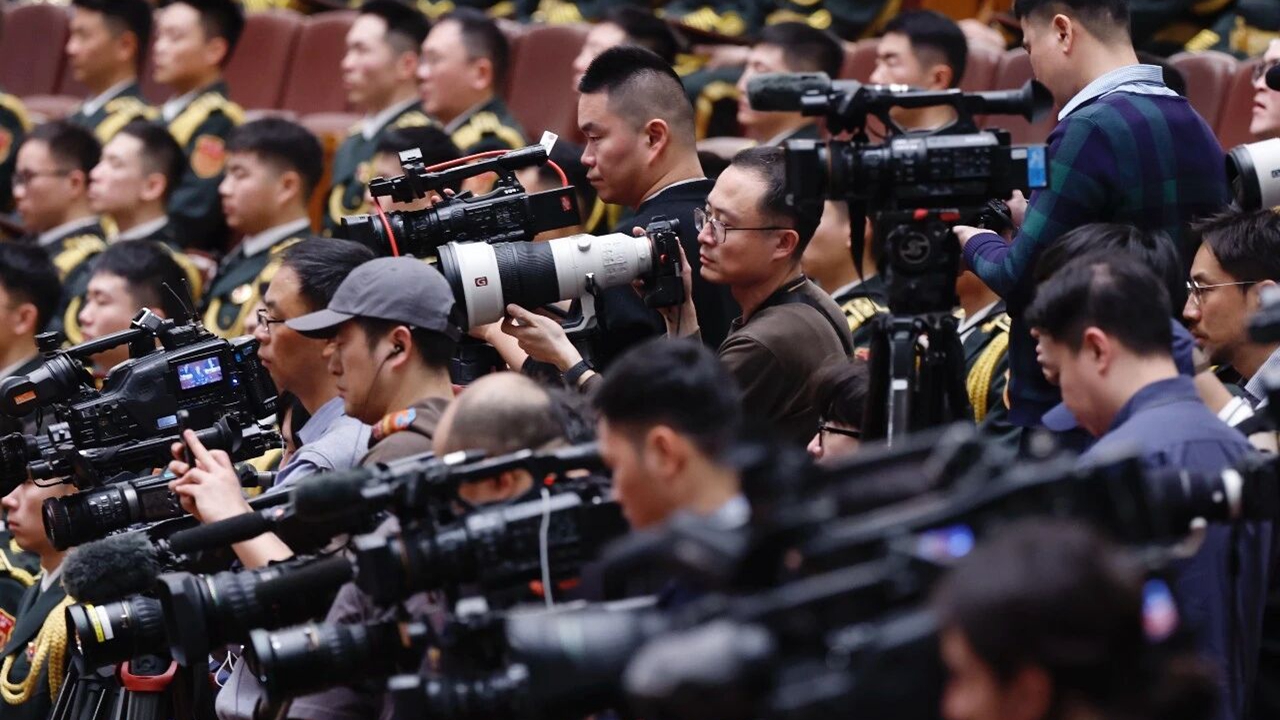
Journalists work at the opening meeting of the fourth session of the 14th National People's Congress at the Great Hall of the People in Beijing.
The 2030 vision: Innovation and "AI Plus"
Over the next five years, China expects to keep its GDP growth within an appropriate range, with annual growth rates to be determined in light of actual conditions, according to the report.
This will lay a solid foundation for achieving the goal of doubling China's 2020 per capita GDP by 2035 to reach the level of a moderately developed country, the report said.
To pursue innovation-led and green development, China projects an annual average increase of at least 7% in nationwide R&D spending, and envisages a total reduction of 17% in carbon dioxide emissions per unit of GDP between 2026 and 2030, it said.
China also proposes raising the value added of core digital economy industries to 12.5% of GDP and life expectancy to 80 years.
To ensure effective implementation of the objectives and tasks of the 15th Five-Year Plan (2026-2030), China proposes a total of 109 major projects in six areas, ranging from steering the development of new quality productive forces to ensuring and improving public well-being, the report said.
Emerging industries
China will accelerate the development of emerging strategic industries including new-generation information technology, new energy, new materials, intelligent connected new energy vehicles, robotics, biomedicine, high-end equipment, and aviation and aerospace during the five-year period.
It will also foster new drivers of economic growth such as quantum technology, biomanufacturing, hydrogen and nuclear fusion power, brain-computer interfaces, embodied artificial intelligence, and 6G mobile communications.
In 2026, the country will foster emerging pillar industries such as integrated circuits, aviation and aerospace, biomedicine, and the low-altitude economy, and nurture industries of the future such as future energy, quantum technology, embodied artificial intelligence, brain-computer interfaces, and 6G technology, the report said.
Foreign investment
During the period, the country will continuously optimize the foreign investment environment, improve services and support for foreign investors, and foster new strengths in attracting foreign investment.
It also pledged to guide foreign investment to flow more to areas such as advanced manufacturing, modern services, new and high technology, as well as energy conservation and environment protection.
Sci-tech innovation
China will build three international centers for sci-tech innovation and turn them into world-class innovation engines and implement strategic deployment in fields such as AI, quantum tech, biotechnology and new energy.
Opening up
China will open wider to the outside world. Efforts will be made to expand market access and open up more areas, particularly in the service sector, the report said.
Opening-up trials will be expanded in fields such as value-added telecom services, biotechnology, and wholly foreign-owned hospitals this year.
The country will also expand opening up in the digital sector, and shorten the negative list of cross-border trade in services.
In the 2026-2030 period, China will improve the mechanism of intellectual property protection aligning with international rules.
Smart economy
China will advance and expand its "AI Plus" initiative, promote faster application of new-generation intelligent terminals and AI agents, and encourage large-scale commercial application of AI in key sectors and fields.
The country will encourage technological innovations in areas including multi-modal AI, AI agent, embodied AI and swarm intelligence, and explore development paths of artificial general intelligence.
Core technologies
China vows to drive advances in original innovation and breakthroughs in core technologies in key fields, and move faster to achieve greater self-reliance and strength in science and technology. It will take extraordinary measures to drive decisive breakthroughs across full chains in integrated circuits, machine tools, high-end instruments, basic software, advanced materials and bio-manufacturing.
Taiwan question
China has pledged to resolutely fight separatist forces aimed at "Taiwan independence" and oppose external interference.
The report stressed the need to fully implement the Communist Party of China's overall policy for the new era on resolving the Taiwan question, reaffirming commitment to the one-China principle and the 1992 Consensus.
China has vowed to promote the peaceful development of cross-Strait relations and advance the cause of national reunification.
Childcare support
China will enhance childbirth support through various economic and social policies, expand coverage of maternity insurance, guarantee maternity leave, and promote the application of assisted reproductive technology. The country will also speed up the building of an inclusive childcare service network and direct housing policies in favor of families with two or more children.